"I can't have bowel movements often if I don't take laxatives" Chronic drug-dependent constipation

Table of Contents
"If I don't take the medicine, my stomach becomes hard like a rock. I can't even last a week."
A woman in her late 40s takes out a small yellow pill, Dulcolax, every morning.
It's a ritual that has been repeating for 5 years.
If I take the medicine, I can go to the bathroom late at night, but,
If not taken, the lower abdomen feels heavy and bloated, and it is uncomfortable even to sit due to gas.
The waistline of clothes is getting tighter, and the number on the scale has increased by 2~3kg.
Even inside the subway on the way to work, the abdominal bloating feels suffocating.
Looking at this woman's pattern in figures makes it clear.
Bowel movement occurs on average 10 to 12 hours after taking the medication,
The amount of stool is large, but it is hard with little moisture.
No bowel movement for 5 to 7 days when not taking the medication,
Abdominal circumference increases by 3 to 4 cm.
Dulcolax (bisacodyl) is a 'stimulant laxative' that induces the defecation reflex by stimulating the colonic mucosa.
The problem is that such stimulation, instead of the autonomous movement of the intestines,
makes them react only to "external signals."
Even when combined with dietary fiber, probiotics, and walking exercise, the effect was limited.
And the gas expansion actually worsened.
At this point, it is not simply a matter of "hard stools,"
but one cannot help but suspect whether the way the intestines function itself has changed.
At first, I thought the cause was a lack of moisture and fiber.
"I drank 2 liters of water a day and ate plenty of vegetables."
However, the constipation interval remained the same.
If the cause were simple, signs of improvement should have appeared within a few weeks.
But there is no change.
"Could it be that my intestines have lost the power to move on their own?"
If the 'autonomous contractile force' that forms and expels stool has disappeared,
recovery is difficult through simple lifestyle habit correction alone.
The problem lies deeper, in the neural networks and muscles inside the intestinal wall,
And it may be in the hormone circuits that tune that rhythm.
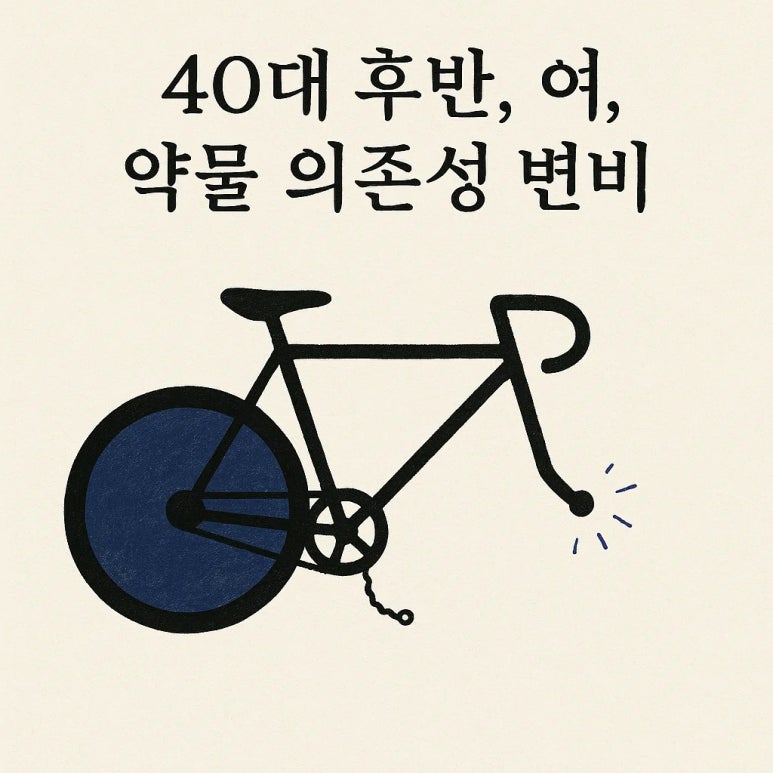
I compare this state to a 'bicycle with the pedals missing'.
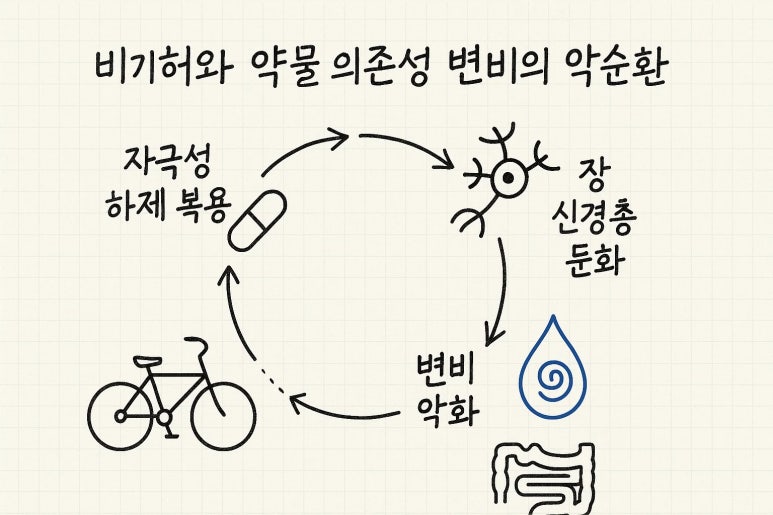
Originally, the intestines move stool as the enteric plexus and intestinal muscles autonomously contract and relax.
However, if they move only through strong chemical stimulation every day,
The intestines forget how to pedal on their own.
In terms of Korean medicine, this state isBigiheo (脾氣虛),
which is viewed as a state where the energy that moves the intestines has weakened.
The transport and transformation function of the spleen is declined, causing the qi of the intestines to be obstructed,
and water metabolism is not smooth, making the stool dry.
The core of treating spleen qi deficiency is
to reinforce the qi of the intestines so that they regain the strength to move on their own.
For this purpose, we use prescriptions centered on ginseng, Atractylodes macrocephala, Poria cocos, and licorice
based on the Sagunja-tang lineage.
If constipation is severe, small amounts of Mirabilite and Rhubarb are combined
to supplement energy while opening blocked pathways Gongbo-byeonghaeng (攻補竝行) strategy is used.
If coldness in the abdomen and decline in energy occur together,
Geonbi-onjung-tang types are selected to restore warmth to the spleen and stomach.
Acupuncture treatment uses points such as Zusanli, Tianshu, and Guanyuan to
stimulate the enteric plexus and promote intestinal motility.
Additionally, abdominal heat therapy and abdominal breathing are combined to
restore the bowel movement rhythm.
This pattern is not a problem for a specific individual alone.
If stimulant laxatives are taken for a long period,
the muscles and nerves of the intestines gradually come to respond only to external stimuli.
As a result, drug dependence worsens,
Secondary symptoms such as gas, abdominal bloating, and weight gain appear.
The solution is not simply 'making one have a bowel movement'.
It is a process of putting the pedals back on the intestines.
While gradually reducing the use of medication,
Herbal medicine to reinforce the energy of the intestines, acupuncture and moxibustion to awaken the intestinal neural network,
A regular bowel movement rhythm and abdominal breathing exercises must be applied together.
"Have you ever experienced being unable to have a bowel movement for several days if you do not take medicine?"
If so, now may be the first opportunity to regain the pedal of your intestines.