
I thought it was just indigestion... but now even stiff shoulders and headaches? | Indigestion, Headaches

Table of Contents
- 1. Indigestion, Headaches, Stiff Shoulders… Why Do They Occur Together?
- 2. Tension Originating in the Stomach Extends to the Shoulders and Head
- 3. Korean Medicine Has Long Understood This Interconnection
- 4. The Wonder of Distal Point Acupuncturing: It Stimulates the Entire Circuit
- 5. The Body Is Not Divided
Hello. This is Baengnokdam Korean Medicine Clinic.
1. Indigestion, Headaches, Stiff Shoulders… Why Do They Occur Together?
Patients who visit us due to stomach discomfort often initially report frequent burping and post-meal bloating.
However, upon further conversation, they often also mention stiff shoulders and a heavy, dull sensation in their head.
Most patients tend to view these symptoms in isolation. They believe their stomach issues are separate, their shoulder pain is due to poor posture, and their headaches stem from fatigue.
However, during examination, it becomes apparent that these three are connected in a single flow.
Particularly, during treatment, we observe very interesting responses. Patients report that their shoulders soften simply by treating their abdomen, and their head feels clearer just by applying acupuncture to their legs.
From a patient's perspective, this might feel like magic, but in reality, it's the result of the body's inherent circuits at work.
2. Tension Originating in the Stomach Extends to the Shoulders and Head
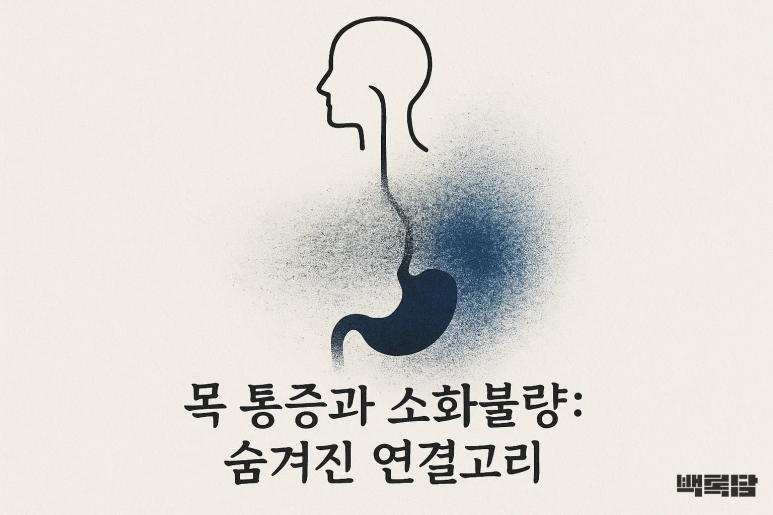
The stomach is not merely an organ for digesting food. It's a complex system deeply connected to the autonomic nervous system, often referred to as the body's "second brain."
Specifically, the stomach is directly connected to the brainstem via the vagus nerve, a crucial neural pathway. The brainstem is not only linked to the stomach but also serves as the origin point for nerves extending to the shoulders, back of the neck, and occipital region.
Therefore, when the stomach is uncomfortable or distended, that stimulus travels up through the brainstem, resulting in tension in the shoulders, stiffness in the back of the neck, and sometimes headaches in the crown or temporal regions.
Especially if headaches worsen after meals, or if you feel shoulder tension when your abdomen feels heavy or tight, it can be seen that this circuit is in an overactive state.
3. Korean Medicine Has Long Understood This Interconnection
In Korean Medicine, such situations are explained using various pathological concepts. Representative concepts include Wi-gi-sang-yeok (Stomach Qi Counterflow), Gan-gi-beom-wi (Liver Qi Invading the Stomach), and Dam-gi-ul-gyeon (Phlegm-Qi Stagnation).
For instance, if the stomach is obstructed and Qi cannot descend, that Qi rises upward. This can cause a heavy feeling in the head, stiff shoulders, and in severe cases, even a sensation of heat rising to the face.
Furthermore, a state known as Gan-gi-ul-gyeon (Liver Qi Stagnation) arises when tension, frustration, and emotional suppression impede the Liver Qi. This obstructed Qi then presses on the stomach, creating a pattern that leads to abdominal tightness and a flushed, hot sensation in the head.
When stagnation in the abdomen affects the upper body in this way, areas like the head, shoulders, and chest simultaneously become tense and accumulate heat.
Expressions we use, such as 'gi-ga-mak-hin-da' (Qi is blocked) or 'gi-un-i-wi-ro-oreun-da' (Qi rises upward), are actually intuitive linguistic descriptions of this physiological interconnectedness.
4. The Wonder of Distal Point Acupuncturing: It Stimulates the Entire Circuit
We often hear a common question in the clinic: 'My shoulder hurts, so why are you placing needles in my hands or legs?'
However, after treatment, patients report that their shoulders feel softer and their head feels clearer. This isn't mere coincidence; it's because stimulating those distal points released the flow of the entire circuit.
For example, Zusanli (ST36) aids stomach movement, Hegu (LI4) regulates Qi in the head and shoulders, and Sanyinjiao (SP6) warms the lower jiao (lower abdomen) to draw Qi downwards.
In other words, even without directly touching the painful area, by regulating the cause and flow of that circuit, symptoms naturally resolve. This is the essence of distal point acupuncturing.
5. The Body Is Not Divided
The conclusion of this discussion is ultimately this: Our body does not operate as separate parts like the head, shoulders, and abdomen.
Within a single circuit, circulation and tension, release and stagnation, all interact and work together.
Therefore, individuals with indigestion may experience shoulder pain, those with persistent shoulder tension may develop a weakened stomach, and if both systems falter, it can ultimately lead to headaches.
Korean Medicine has explained this complex interconnectedness through the concepts of Qi and meridians, and this understanding aligns with modern medicine's perspectives on the nervous system and autonomic regulatory systems.
Rather than simply treating a single symptom with painkillers, Korean Medicine takes the perspective of understanding why that symptom appeared and where it originated. That is the strength of Korean Medicine, and it is also why its treatments can sometimes feel magical.
#Indigestion #IndigestionHeadache