Aching All Over? Does Your Pain Move From Place to Place? | Incheon Fibromyalgia

Table of Contents
Hello.
This is Yeonseung Choi, a doctor of Korean medicine at Baengnokdam Korean Medicine Clinic.
The Strange Symphony of Pain My Body Plays
“I can't pinpoint one specific spot. It just feels like my whole body is screaming in pain.”
This is the 'unexplained generalized pain' I often encounter in my clinic.
Its onset is complex.
A heavy, low-pitched pain, like cotton soaked in water.
Sharp, high-pitched pains that stab here and there without warning.
And over all these sounds, a fog-like noise, 'brain fog,' settles.
It is sometimes given the name fibromyalgia.
But after numerous tests, the diagnosis is always the same:
“There are no specific abnormalities.”
A deep sense of isolation sets in.
A noisy cacophony echoing in the concert hall of my body.
It feels like being the only audience member listening to that sound.
Today's story begins with that solitary sensation.
If There Is No Free Flow, There Is Pain (不通則痛), But…
In Korean medicine, there is a fundamental principle for understanding pain.
It is 'Bul-tong-jeuk-tong (不通則痛)'.
It means 'if there is no free flow, there is pain.'
However, not all 'lack of free flow' are the same.
A bruise from a fall, post-surgical pain.
The cause is 'eohyeol (瘀血)' or stagnant blood.
Like a violin with a broken string, the cause and location are clear.
But the pain we are facing now is different.
It's not that individual instruments are broken.
It's highly probable that there's a problem with the entire orchestra's 'performance'.
The instruments are fine, yet only terrible noise echoes. That is precisely it.
The Source of All Noise: An Overly Sensitive Conductor's Baton
Where is the true origin of this discord?
Numerous studies and clinical experiences point to one place.
It's not the individual musicians.
It is the 'conductor' who directs the entire orchestra – our 'brain and nervous system'.
Modern medicine calls this 'central sensitization'.
It's due to the conductor being overly fatigued and sensitive.
Even at a faint sound not on the score, they flail the baton wildly.
This is why even stimuli that others don't perceive cause extreme pain.
'Brain fog' can also be added to this.
The conductor's mind is filled with fog (known as 'dam-eum' or 'phlegm-fluid' in Korean medicine),
a state where they can't even read the score.
This is why pain and cognitive impairment appear together.
Here, our inquiry deepens.
The fog clouding the conductor's mind, 'dam-eum (痰飮)' in Korean medicine.
How does this connect to 'neuroinflammation' in neuroscience?
I propose a hypothesis.
This waste product, 'dam-eum'.
Perhaps chronic inflammation originating in the gut could be the 'missing link'
that sensitizes the brain's pain system.
Diagnosis in Korean Medicine: Why Did the Orchestra Collapse?
Supporting this hypothesis,
Korean medicine views the fundamental causes dimensionally across three levels.
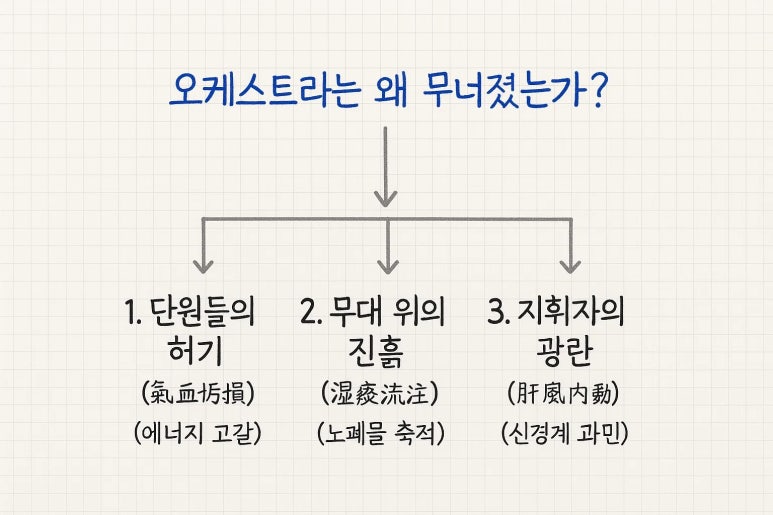
First, the musicians' hunger (Qi-Blood Deficiency, 氣血虛損).
A state where they are so starved for days that they lack the strength to even hold their instruments. The body's energy and nutrients are depleted.
Second, mud on the stage (Accumulation of Dampness and Phlegm, 濕痰流注).
A state where it's hard to move due to sticky mud.
Waste products called 'seup-dam (濕痰)' or damp-phlegm have accumulated in the body.
Third, the conductor's frenzy (Internal Stirring of Liver Wind, 肝風內動).
A conductor who has lost balance due to stress and energy depletion.
It's a state where they react hysterically to minor stimuli, over-exciting the nervous system.
This is the essence of the complex condition of 'ju-bi (周痺)' and 'dam-eum (痰飮)' as described in the *Donguibogam*.
Pain that moves around the whole body and makes the body feel heavy.
A Single Customized Score for the Orchestra
So, how do we resolve this overall predicament?
The goal of treatment is clear.
It is not to silence the musicians (painkillers) because they are noisy.
When faced with such complex conditions,
treatment is not a process of finding a fixed answer.
It's more like a journey of setting out together to find a path, following the subtle clues given by the patient's body.
The Korean medical approach addresses these three problems simultaneously.
The goal is to create a single, integrated prescription, a 'customized score'.
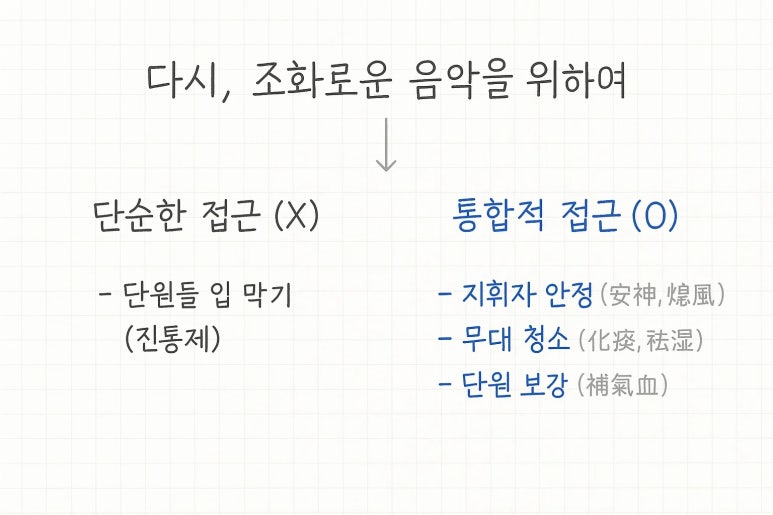
For example, Ondamtang (溫膽湯, Warm the Gallbladder Decoction) clears the mud from the stage and stabilizes the conductor.
To this, we add a melody that supplements Qi and Blood (補氣血, Bu Qi Xue) for the hungry musicians.
We also add a harmony that calms the conductor's frenzy (熄風, Xi Feng, Extinguish Wind).
Thus, a 'customized score' is completed for each individual patient.
This holistic approach.
Helping the orchestra of my body play harmonious music once again.
That is the goal of this long journey.