
Why Does Persistent Dry Cough from Reflux Laryngitis Not Get Better Even with PPI Medication? | Incheon Reflux Laryngitis

Table of Contents
- 1. “They say the cough isn't a cold”
- 2. There is a name for the disease, but the diagnosis is ambiguous — What is LPR?
- 3. GERD and LPR are completely different diseases — Concept and History
- 4. Why is treatment difficult — Reasons for the futility of PPIs
- 5. Oriental Medicine Interpretation — Upward Surge of Qi, Failure of Coordination between Lung, Stomach, and Liver
- 6. Treatment is Coordination, Not Suppression — Restoring the Flow
- 7. “You are not sensitive — it is a living reaction”
— “Reflux that only affects the throat, how should we understand this disease?”
1. “They say the cough isn't a cold”
Hello. This is Baekrokdam Korean Medicine Clinic.
In the consultation room, I often hear things like this.
“I thought it was a cold, so I took cough medicine and cold medicine... but it hasn't gotten better even after a month.”
“My nose isn't blocked and I have no fever... my throat just keeps feeling ticklish, so I keep clearing my throat.”
“If I talk for a little while, my throat feels scratchy and my voice quickly becomes hoarse.”
“At night, I wake up because it feels like my throat is burning. The dry cough continues.”
When the cough does not improve after 3 weeks, 4 weeks, or even several months, you hear from the hospital that “the lungs are clear, it's not a cold... it seems you're just a bit sensitive.”
And some people even had a gastroscopy, but were told “both the esophagus and stomach are clean.”
At this point, people around you start saying things.
“Why are you making such a fuss over a little coughing?”
“Everyone feels that way to some extent.”
But the person themselves knows. This is truly at a level that is inconvenient in daily life and even disrupts their sleep at night.
2. There is a name for the disease, but the diagnosis is ambiguous — What is LPR?
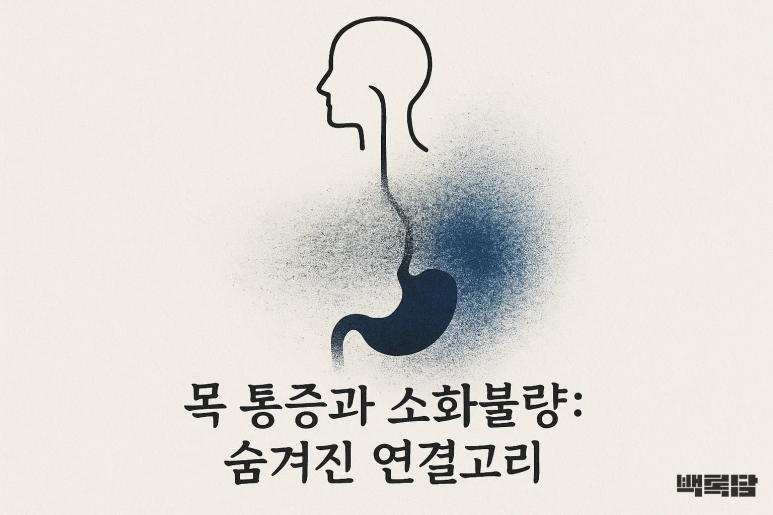
In such cases, one disease name appears. It is ‘Laryngopharyngeal Reflux’, or in English, LPR (Laryngopharyngeal Reflux). This refers to a state where stomach acid or stomach contents go beyond the stomach, pass through the esophagus, and rise up to the larynx and pharynx, namely near the throat and vocal cords.
However, the diagnosis of this disease is very ambiguous. Even with an endoscopy, the esophagus is fine, and in many cases, it is not clear whether the stomach acid is acidic or not.
Therefore, while a diagnosis of “it looks like LPR” may be given, not many doctors say “it is definitely LPR.”
Furthermore, since visible abnormalities do not often appear on CT or MRI, from the patient's perspective, it feels like a disease where the illness exists, but the evidence does not. That is why it is even more frustrating.
3. GERD and LPR are completely different diseases — Concept and History
There is one important difference here. ‘Gastroesophageal Reflux Disease’, or GERD, which we are well aware of, is when there are clear esophageal symptoms such as heartburn, belching, acid regurgitation, and chest pain. However, LPR presents symptoms further up, in the pharynx, larynx, vocal cords, and the entrance to the airway. Typical symptoms include coughing, a foreign body sensation in the throat, a hoarse voice, and dryness of the pharynx.
LPR as a concept only began to be organized separately in the 1990s; before that, it was simply regarded as a peculiar symptom of GERD. However, it is now the established theory that the two diseases have completely different clinical pathways.
The important thing is that not all GERD patients have LPR, and not all LPR patients experience heartburn or frequent belching.
4. Why is treatment difficult — Reasons for the futility of PPIs
Then, when such a diagnosis is made, what is the first treatment received? Usually, PPI, or proton pump inhibitors, are prescribed. These are drugs like Nexium, Pariet, and Omep.
But the problem is this. Even after taking the medication for several weeks, the symptoms hardly decrease. Why is that?
- First, the irritants in LPR are not only acidic stomach acid. Pepsin, bile, and gas rising from the stomach can irritate the larynx even if they are not acidic.
- Second, the sensitivity of the larynx is much higher than that of the esophagus. Even if the same reflux occurs, the esophagus may not react, while the vocal cords or pharynx react sensitively with coughing or pain.
.
- Third, there are cases where stimulation is exaggerated even with minute reflux. In reality, there is little reflux, but because the laryngeal mucosa has already become sensitive, coughing is repeated.
5. Oriental Medicine Interpretation — Upward Surge of Qi, Failure of Coordination between Lung, Stomach, and Liver
In Oriental medicine, this state is viewed as 'Wi-gi-bul-gang' (stomach qi not descending) or 'Qi-ui-sang-yeok' (upward surge of qi). Energy should descend, but it becomes congested and surges upward. This rising energy stimulates the lungs to induce coughing, dries out the fluids of the vocal cords and pharynx, and puts the autonomic nervous system in a state of arousal, which even interferes with sleep.
In particular, cases where coughing is severe at night or waking up in the early morning with a dry throat are also signs of core body temperature regulation issues and sympathetic nerve hyperactivity.
Furthermore, if this state persists, it easily leads to a flow of liver congestion and decreased stomach function: Liver Qi Stagnation → Stomach Qi Deficiency and Coldness → Internal Accumulation of Phlegm-Dampness. This is not simple gastric acid reflux, but a state close to a failure of regulation for the entire body.
6. Treatment is Coordination, Not Suppression — Restoring the Flow
In Oriental medicine, we do not unconditionally try to suppress the cough in such cases. This is because coughing is a 'reaction to expel,' not the 'problem itself.' The real problem lies in restoring the structure of why the stomach energy keeps surging upward, why the vocal cord and pharyngeal mucosa have become so sensitive, and why the sympathetic nerve is repeatedly excited during sleep.
Therefore, treatment is designed as follows:
- Acupuncture to help regulate the autonomic nervous system: stabilizing the flow of the cervical spine, thoracic spine, and thoracic lymphatics
- Herbal medicine to resolve heat and phlegm around the throat: customized based on syndrome differentiation, such as Sagan-tang, Gami-sayeok-san, Cheongyeol-hwadam-bang, etc.
- Stabilizing nighttime sleep and upper body inclination: using cushion support during sleep, ensuring a fasting period of more than 2 hours after meals
- Combining stretching and breathing techniques to relieve qi stagnation
7. “You are not sensitive — it is a living reaction”
PPIdoes not work, cough medicine is ineffective, and since tests show everything is normal, you might think, “Am I the only one who is strange?” However, this is not because you are sensitive. This is evidence that a living body is feeling stimulation and reacting.
It is time for treatment that interprets and regulates that flow, rather than medications that suppress it. Coughing may not be a symptom that must be stopped, but a language of the body that we must understand.
#IncheonRefluxLaryngitis #DryCough #RefluxLaryngitis