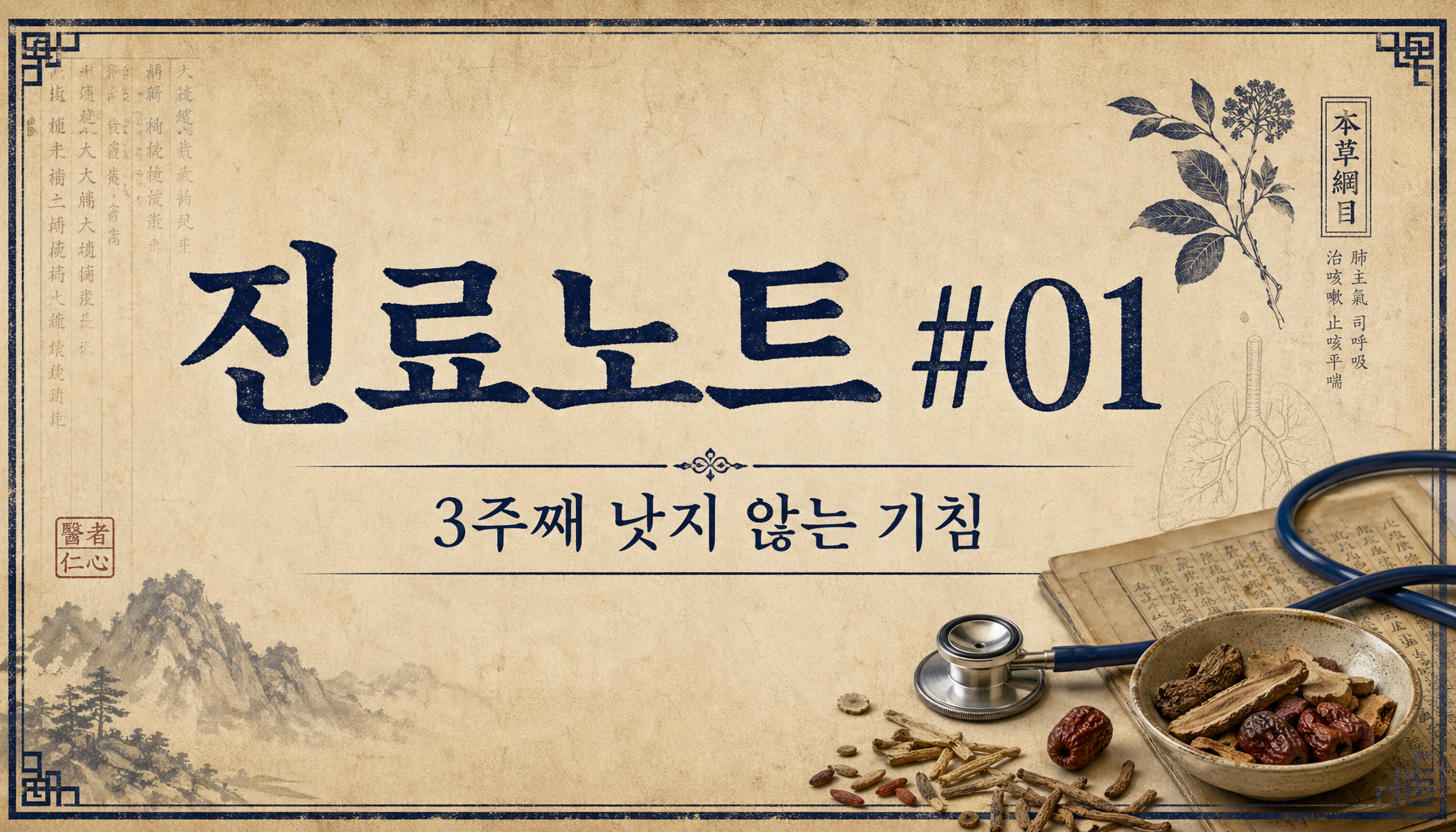
Clinic Diary #01 — Three-Week Lingering Cough

Table of Contents
Clinical Notes #01
A Cough That Won't Go Away After 3 Weeks
A few days ago, a patient came to the clinic. She was in her late 30s, raising her first child, and pregnant with her second. Her belly was just starting to show.
The first words the patient spoke were:
"This is the first time I've coughed for this long since middle school."
The cough started three weeks ago. At first, she thought it was a common cold. She had no fever or chills, just a tickle in her throat and a cough. She visited a local internal medicine clinic and received 6-7 days' worth of medication. For the first few days, she felt better. She thought, "Ah, I must be recovering," but after finishing the medication, the cough returned a few days later, much worse than before.
"It feels like it's getting better, then it comes back... I'm pretty exhausted now."
It was worse at night. When she lay down to sleep, the cough wouldn't stop. "When I lie down, I get short of breath and start coughing, so I can barely fall asleep." She also experienced shortness of breath and coughing fits when walking. It was somewhat better during weekdays, but worsened as evening approached and night fell. Her phlegm was sticky and light yellow. Her throat hurt too. When she coughed, she felt significant pain in her ribs.
"Every time I coughed, I felt like my ribs were breaking. It hurt so much I couldn't even lie down."
She had undergone major surgery a few years ago. She also mentioned having been quite ill with pneumonia as a child.
In Korean traditional medicine (KTM), even a single cough is viewed from multiple perspectives. Instead of simply looking for a 'cough suppressant,' we try to read the signals the cough is providing.
Several signals were discernible from this patient's cough.
First, the phlegm was yellow and sticky. This was a sign that 'heat phlegm' (熱痰, yeoldam) remained. After the cold, the inflammation had not completely resolved and lingered in the bronchi, generating heat, which in turn made the phlegm sticky and yellow.
Second, the cough worsened when lying down at night. This indicates a state where the lung qi (氣, energy) cannot descend normally and instead rushes upward. In Korean traditional medicine, this is called 'lung qi upward reversal' (肺氣上逆, pyegisangyeok). Additionally, in the later stage of pregnancy, the enlarged uterus pushing the diaphragm upward, thereby narrowing the respiratory space, likely also contributed to this.
Third, it had persisted for over three weeks and recurred after internal medicine treatment. She had not fully recovered from the cold. It's possible that her past history of surgery and pneumonia was affecting her overall condition. Her body hadn't accumulated enough strength to recover, leading to a prolonged cold and chronic cough.
The treatment approached with three goals:
First, resolve the remaining inflammation. The inflammation can be considered controlled when the yellow phlegm disappears. Changes in the color and viscosity of the phlegm are the most direct indicators.
Second, calm the upward-rushing cough. This involves helping the lung qi circulate stably. The focus was particularly on improving the pattern of worsening cough when lying down at night.
Third, replenish depleted body fluids (Jinyeok). A prolonged cough consumes lung qi and body fluids. The pattern of alternating dry coughs and phlegm is also a sign of fluid depletion.
A prescription aligned with these goals was selected. It primarily consisted of herbs that moisten the lungs and calm coughs, with a small amount of additional herbs to aid phlegm expulsion. Considering her pregnancy, we started with a lower dosage than usual and decided to carefully monitor her progress.
To understand this patient's cough, one must also consider her life context. She was juggling raising her first child, pregnancy, and work life. She wasn't getting enough sleep, and her body had no time to rest. In such a state, recovery from a cold is bound to be slow.
Traditional Korean medical treatment doesn't end with just prescribing medication. It's a process of understanding the patient's situation and adjusting the treatment direction to fit that context. For this patient, 'how much rest she could get' was as important a therapeutic factor as 'what was prescribed.'
The first observation point was how the frequency of her cough and the nature of her phlegm changed after one week. If the cough decreased and the phlegm began to clear, it would indicate that the treatment direction was correct. If the response was good, there was a high likelihood of gradual recovery even without further reinforcement. Of course, individual responses to treatment vary. Even for the same cough, the approach differs depending on the cause, constitution, and situation.
This article was written to convey, even in a small way, how Traditional Korean Medicine views illness through a single clinical case. It is a clinical essay reconstructed based on actual clinical experience, and the patient's personal information has been protected. For individual health conditions, please consult with a specialist.