
Difficulty Swallowing Food — Sensation of a Lump in the Throat | Incheon Damjeok Disease

Table of Contents
- 2. The problem isn’t the ‘stomach,’ but the ‘diaphragm and Qi flow’
- 3. From a Korean Medicine perspective, a complex pattern of ‘Plum-pit Qi’ (Maekhegi) + ‘Qi Stagnation’ (Giche) + ‘Phlegm-Heat Ascending’ (Damyeolsangyeok)
- 4. Most patients with these symptoms begin by saying, ‘I have indigestion’
- 5. Strategy for Recovery: Pressure Restoration → Qi Circulation Restoration → Sensory Stabilization
- First, relieving the pressure
- Second, restoring Qi circulation
- Third, separating fear from sensation
- 6. The sensations aren’t wrong; they are ‘highly accurate signals’
Hello. This is Baengnokdam Korean Medicine Clinic.
“Every time I eat, it feels like something is stuck in my throat. It feels like food stops halfway when I swallow.”
“I have to mash my food to swallow it. I can’t burp, and my chest and throat feel completely blocked.”
“It’s so suffocating that I can barely breathe. I’m scared to eat; mealtimes have become a source of terror.”
You’ve probably heard these kinds of statements a lot from others, or even said them yourself, haven't you?
Some call it gastritis, others say it's just indigestion, and some suggest it might be a panic attack.
However, in reality, no abnormalities show up in any tests, yet the body is clearly uncomfortable and sending alarming signals.
In such cases, we must interpret each and every expression the patient feels as a real anatomical and physiological clue.
2. The problem isn’t the ‘stomach,’ but the ‘diaphragm and Qi flow’
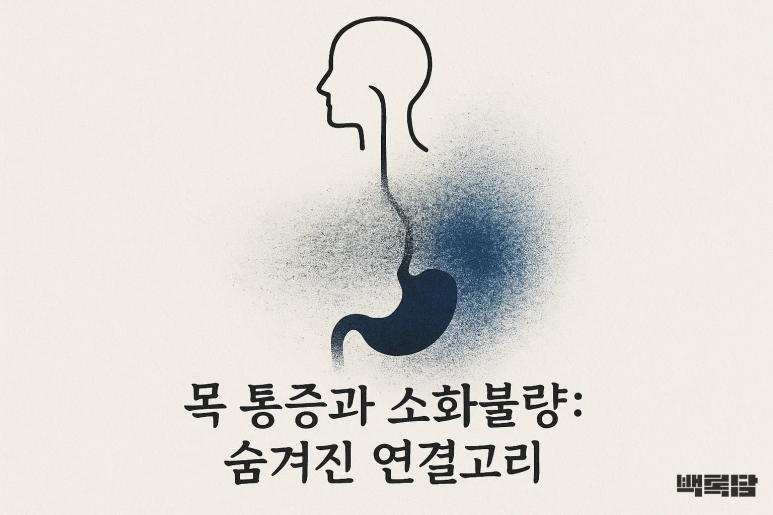
When food enters, it should go down to the stomach, right? But some people feel like it stops in their chest. Why is that?
One key factor is the movement of the diaphragm. The diaphragm is a muscle that separates the thoracic cavity and the abdominal cavity, but due to stress, tension, or subtle changes after surgery, the diaphragm often fails to descend and remains ‘locked’ in an elevated position.
What this means is—after eating, the stomach should open downwards, and gas should escape upwards, but that flow gets blocked. This creates a feeling of pressure, as if food is stuck halfway.
What if the vagus nerve is hypersensitive in addition to that? Then, you can't burp, your breathing becomes shallow, and a feeling of ‘blockage’ rises all the way to your throat.
3. From a Korean Medicine perspective, a complex pattern of ‘Plum-pit Qi’ (Maekhegi) + ‘Qi Stagnation’ (Giche) + ‘Phlegm-Heat Ascending’ (Damyeolsangyeok)
In Korean medicine, this condition is understood as a complex pathological state, as follows:
- Plum-pit Qi (梅核氣): Liver Qi stagnation (Gan-gi-ul-gyeol), where tension and suppression rise to the throat, creating a sensation of a foreign body that cannot be swallowed.
- Upward-Rebelling Qi (氣逆): A feeling of breathlessness, inability to burp, and stuffiness that occurs when Qi, which should naturally descend, rises upwards.
- Phlegm Stagnation (痰滯): Accumulation of body fluids forming sticky, phlegm-like substances that block the flow.
- Phlegm-Heat Ascending: Unpleasant and sharp symptoms that arise when phlegm, accompanied by heat, ascends upwards (e.g., burning sensation, aversion to wind, sensory hypersensitivity).
When these three aspects overlap—although nothing appears in tests—the patient experiences a complex feeling of pressure, as if their throat, chest, solar plexus, and stomach are all literally blocked.
4. Most patients with these symptoms begin by saying, ‘I have indigestion’
But we shouldn't simply view this as mere indigestion. This is because they tell us things like:
- “My food won’t go down.”
- “Something feels stuck in my throat, so I keep swallowing.”
- “I can’t burp. It feels like it’s rising all the way to my chest.”
- “I keep gulping down air. That makes it even more suffocating.”
- “If I just sit still, something inside me rumbles and churns.”
This is not simply a problem of stomach acid, nor solely an esophageal issue. The pressure that deep breaths cannot alleviate, the fear of the act of swallowing itself, and repeated self-observation are issues that go beyond the mechanical functions of the body.
5. Strategy for Recovery: Pressure Restoration → Qi Circulation Restoration → Sensory Stabilization
To recover from these symptoms, three approaches are necessary.
First, relieving the pressure
- To allow the diaphragm to descend naturally.
- Abdominal breathing exercises.
- Inducing diaphragmatic recoil in a prone position.
- Upper gastrointestinal release massage.
- Relaxing acupuncture treatment for the thoracic region (e.g., Jungwan (CV12), Geogeol (CV14), Danjung (CV17)).
Second, restoring Qi circulation
- Herbal remedies from the Banha-hubak-tang / Ondam-tang / Sogi-hwajung-tang lineages.
- Herbal medicine focused on resolving Qi stagnation.
- Releasing Qi flow through acupoints such as Naegwan (PC6), Sinmun (HT7), and Joksamni (ST36).
Third, separating fear from sensation
- Creating a pre-meal routine: adjusting posture, breathing, and eating speed.
- Gradual exposure strategy for food-related fears.
- Education on the ‘interpretation of meaning’ for sensory hypersensitivity (helping patients internalize that these sensations do not signify harm).
6. The sensations aren’t wrong; they are ‘highly accurate signals’
We often say, “It’s due to stress,” “Perhaps some stomach acid came up,” or “It’s probably nothing serious.”
However, the patient clearly feels it and continuously tracks that sensation within their body. That sensation is not incorrect; it is an accurate signal that the internal pressure flow is misaligned.
Therefore, our task is to interpret those signals, clear the path, and help them breathe freely again.
I hope this message reaches those who are currently experiencing a blocked throat, fear of eating