
I have indigestion... why does my back hurt? | Incheon Indigestion Back Pain

Table of Contents
Hello. This is Baekrokdam Korean Medicine Clinic.
Today, let's start with a symptom we hear very often in the clinic, but one that's easy to overlook.
"Doctor, for me... when my stomach feels bad, my back always hurts."
We hear this a lot. People often ask, "Is it a posture problem?" or "I thought it was muscle stiffness so I put on a patch, but it didn't get better..." complaining of stiffness and pain in that exact area: below the chest, the center of the back, and inside the shoulder blades. We see several such patients every day.
But most of these patients also mention that they have indigestion, frequent acid reflux, or a feeling of stuffiness in their stomach after eating. What's interesting is that the painful areas they describe are all exactly the same.
I recall one patient who said, "My breath catches, and my back becomes as hard as a rock" whenever they ate a little too quickly or overate. Their back pain was so stiff that they would apply three patches a day before sleeping, and they found comfort only by placing a pillow behind their back when lying in bed.
Initially, they didn't believe that it was "because of a poor stomach."
"My stomach is my stomach, and my back is my back. Are they really connected?"
That was their reaction—but yes, they are truly connected. And quite precisely, at that.
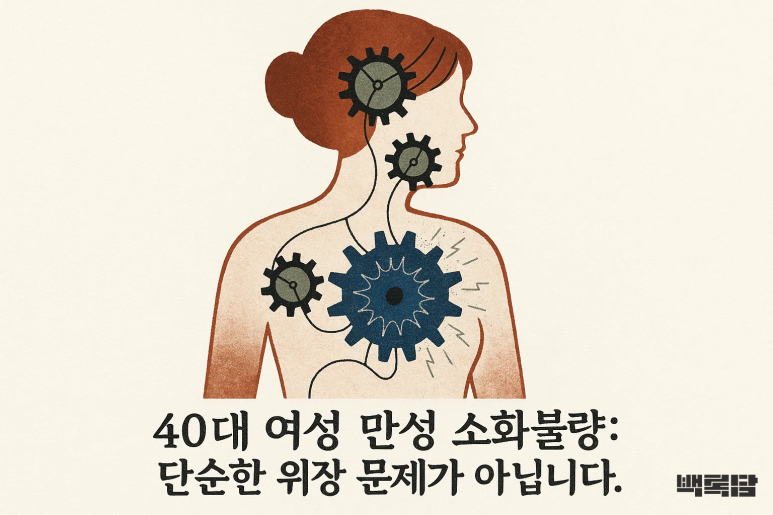
Organs in our body such as the stomach, liver, pancreas, and gallbladder are connected to the sympathetic nerves originating from the spine, specifically from thoracic vertebrae T6 to T10. This means that when the stomach receives a stimulus, that stimulus travels along the nerves and is also transmitted to the nerve segments in the back.
And at that time, back muscles like the erector spinae, latissimus dorsi, and intercostal muscles reflexively begin to stiffen. Simply put, it's natural for your back to react when your stomach is uncomfortable. Conversely, if your back is constantly stiff, your stomach cannot be comfortable either.
Baesuhyeol in Korean Medicine
In Korean medicine, these are referred to as 'Baesuhyeol' (Back Shu Points). Gan-su (Liver Shu), Bi-su (Spleen Shu), Wi-su (Stomach Shu)... these are all acupuncture points located near the spinal line. These points are not merely spots for acupuncture needles; they are autonomic nervous system reflex points connected to their respective organs. Therefore, when the stomach is tense, tenderness develops in these areas, and often, properly releasing these points significantly improves digestion.
Misconception and Truth
Now, we need to address a misconception. It's not that your stomach feels bad because your back is stiff; rather, it's more often the case that your back is stiff because your stomach is unhealthy.
And what's important is that this stiffness isn't merely a muscle issue; it's a 'structure created by a tense nervous system.' Simply loosening the back muscles won't resolve it.
When manual therapy offers only temporary relief before the stiffness returns, and stretching doesn't provide lasting comfort... in such cases, acupuncture needles must be inserted along the spinal line of the back, focusing on the Baesuhyeol points. Only by stimulating the root of those nerves can the brain recognize, "Ah, things are better now."
Treatment Methods
This is why where the acupuncture needles are placed is crucial. For example, spinal segments T6-T9, connected to the stomach, and T7-T10, connected to the liver and gallbladder... these segments are like highways where the erector spinae muscles of the back and the sympathetic nerves of the stomach pass through simultaneously.
By directly needling these points to relieve tension, and simultaneously addressing abdominal tender points—such as Jungwan (CV12), Cheonchu (ST25), and Joksamni (ST36)—then both the back and the stomach can truly relax.
Actual Treatment Process
When this is translated into actual treatment, it proceeds as follows:
- Stabilize the sympathetic nerve segments along the spinal line of the back, focusing on the Baesuhyeol points, and simultaneously stimulate the abdominal tender points of the same segments.
- Herbal medicine is prescribed to focus on 'nervous system stabilization' and 'stomach qi circulation' rather than merely suppressing stomach acid. Xiangsha Yangwei Tang or Jiajian Wendan Tang may be used, or if the nerves are highly sensitive, small amounts of formulas containing Poria and Coptis are administered.
- If back pain is severe after meals, it's not due to indigestion but rather an overreaction of the sensory nerves. In such cases, patients should not lie down immediately after eating; instead, they should sit and practice diaphragmatic breathing for at least 5 minutes. After that, they should gradually begin to move.
So, I told my patient this:
"This isn't merely a problem with your back. Your back hurts because your stomach is unhealthy, and your brain is simply translating that as pain."
"It's not that your stomach will feel comfortable once your back relaxes; rather, your back will truly relax only when your stomach feels comfortable."
Conclusion
The conclusion is this: when your stomach feels unwell, you must examine the back, and when your back hurts, you must examine the stomach simultaneously. The true connection is hidden within the invisible nerves. Acupuncture, too, must follow these pathways to properly listen to the body's language and respond effectively.
Thank you.
#IndigestionBackPain #BackPain