
Why Reflux Esophagitis Causes Back Pain

Table of Contents
It's not just a coincidence. It's common to hear people complain of back pain when they have indigestion. Indeed, patients often express this, saying things like, "My back stiffens whenever my stomach feels off," or "The inside of my left shoulder blade feels tight." Most people tend to dismiss these as separate symptoms, assuming back pain is due to muscle or posture issues, and stomach discomfort is simply a digestive problem. However, these two are far from unrelated.
In fact, it's something we've simply overlooked: the stomach and back are anatomically, neurologically, and functionally a tightly interconnected circuit. When your back and stomach hurt simultaneously, it's not a coincidence, but rather the result of sophisticated communication within your body. And the moment you understand this connection, you'll begin to view your indigestion and recurrent back pain from an entirely new perspective.
The Stomach and Spine Are Connected by Nerves
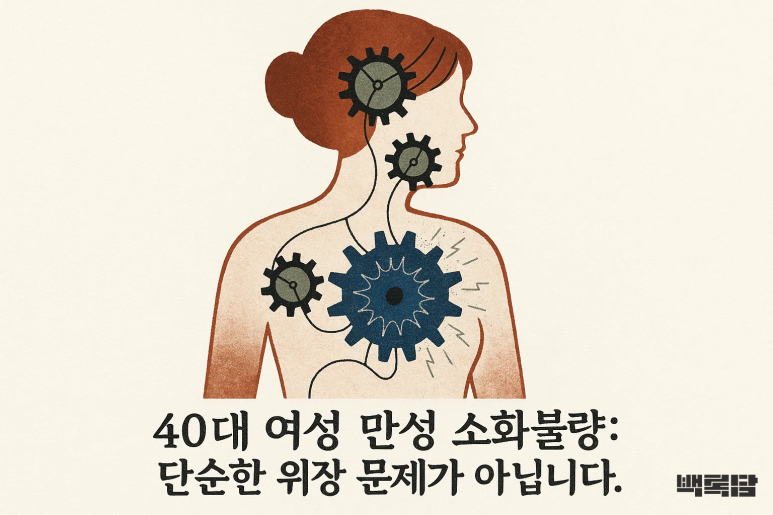
The digestive system is not merely a fixed organ in the abdomen. The stomach is also a 'sensory organ' that constantly undergoes subtle movements, changes, and receives stimuli. This stomach is connected to the central nervous system via sympathetic nerve segments at the mid-thoracic spinal cord, specifically levels T6-T9. The issue lies in the fact that these nerves also share sensory and motor information with the back muscles.
When the stomach distends or expands, the stimuli are transmitted to the central nervous system via the sympathetic nervous pathway. In this process, a reflexive tension response also occurs in the back muscles that share the same spinal segment. The reason why gastrointestinal issues lead to stiffness and aching in the medial scapular area, and a heavy sensation under the shoulder blade, originates from this structural pathway. Medically, this is referred to as a viscerosomatic reflex, or visceral referred pain.
An Immobile Body, A Stagnant Stomach
If you think about it, days when you experience indigestion and back pain often coincide with recurring similar lifestyle patterns: days spent sitting for long hours, days without exercise, days when stress built up but couldn't be released. During such times, we often find ourselves hunched forward with a slouched posture, taking shallow, tense breaths.
This posture inhibits the movement of the diaphragm. The diaphragm is not merely a respiratory muscle; it's a physiological pump that compresses and shakes the internal organs vertically, maintaining their rhythmic function. With each breath, the diaphragm moves down and up, repeatedly pressing on and releasing the stomach and other organs. This forms the mechanical basis of peristalsis.
Organs Are Living Structures
French osteopath Jean-Pierre Barral precisely understood this structural loop. He posited that internal organs are not mere fixed entities, but rather possess their own intrinsic motility. The stomach performs its normal functions by repeating subtle patterns of contraction and relaxation, rotation, and oscillation.
However, when these movements are inhibited by external structures, or when fascia tightly constricts them, or when autonomic nervous system tension is maintained, the stomach's rhythm collapses. In such cases, even if the stomach doesn't actually lose its function, it becomes an 'immobile organ'.
Movement Is The Language Of Organs
This perspective is not unique to Western thought; it also aligns with Eastern traditions. In the Donguibogam (Principles and Practice of Eastern Medicine), it is stated: “四肢為脾之外使”, meaning the movement of the four limbs serves as an external envoy for the spleen and stomach. This implies that the four limbs—arms and legs—are an extension of movement and a neural network connecting the digestive system to the outside world. Every action we take—walking, swinging our arms, twisting our torso, and taking deep breaths—physically stimulates the organs and serves as a self-regulating means to restore their rhythm.
Look Not At Symptoms, But At The Flow
Back pain during indigestion is not a mere double malfunction that coincidentally occurs. It is the result of a disrupted body rhythm. The stomach and back are connected as a single circuit, and posture, breathing, emotions, and movement are supporting actors that continuously tune this circuit. What we can do is not eliminate symptoms, but restore the flow.
The acts of breathing, moving, correcting posture, and relaxing the back are not just simple fatigue recovery. They are signals that digestion is restarting, and the rhythm of recovery we allow ourselves. The body is connected, and that connection speaks without words.
#AcidReflux #IncheonAcidReflux #BackPain #AcidRefluxBackPain