Blisters and Peeling Skin on Fingers: Is It Keratoderm or Herpes?

Your hands, which have run without rest into your late 40s. One day, you suddenly discover small blisters and itching on your fingers. You tried to brush it off as nothing significant, but as the skin begins to peel, it becomes increasingly bothersome. When you search for 'finger blisters' on the internet, a flood of unfamiliar medical terms pours out.
|
"It's itchy and the skin is peeling, so I'm completely confused whether this is keratolysis or dyshidrotic eczema." |
This article is a guide for those of you in the midst of that confusion.
Chapter 1. Two Diseases Under Suspicion: The Identity of Keratolysis and Dyshidrotic Eczema
First, let's check the profiles of the two 'suspects.' While these two may look similar, their essence is completely different.
Keratolysis Exfoliativa, commonly referred to as keratolysis, can be compared to 'quiet peeling without inflammation,' as the name 'Exfoliativa' suggests. It is a phenomenon where the stratum corneum, the outermost layer of our skin, peels off on its own due to external stimuli. The key is that it is 'non-inflammatory.'
On the other hand, Dyshidrotic Eczema is like a 'small rebellion inside the skin.' Contrary to its name, it is not directly related to sweat, and it is a type of recurrent eczema where small blisters form on the hands and feet. The key is that it is an 'inflammatory' disease related to the immune system.
Chapter 2. Decisive Evidence: Key Clues Distinguishing the Two Diseases
Now it is time to distinguish between the two suspects. If you examine the symptoms meticulously, as a forensic scientist analyzes evidence, you can discover the decisive differences.
|
Category |
Exfoliative Keratolysis (Keratoderma) |
Dyshidrotic Eczema |
|
Clue 1: Itching |
Almost none or mild. |
Severe, accompanied by a burning sensation. |
|
Clue 2: Blisters |
Shallow and air-filled appearance, burst easily. No oozing. |
Deep and firm (tapioca pearl shape), do not burst easily. |
|
Clue 3: Inflammation |
None (No redness, swelling) |
Possible (Area around blisters may become red or swollen) |
|
Key Summary |
"No itching, only peeling" |
"Intensely itchy with small blisters" |
|
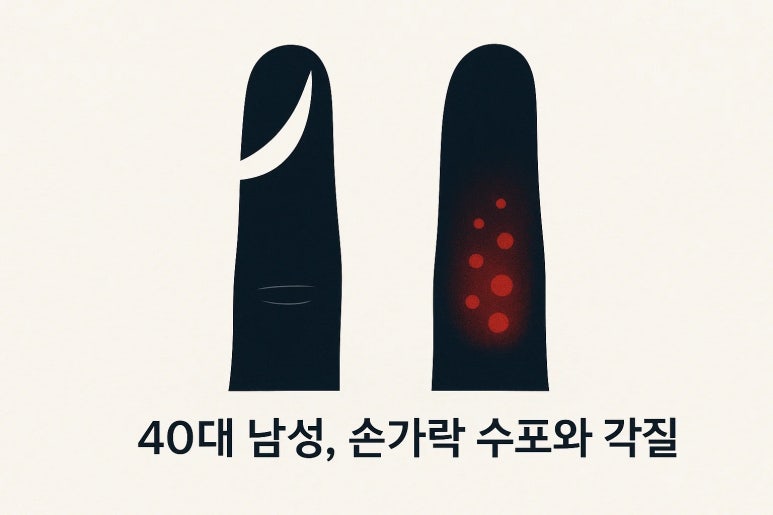
[Example of observation over time] Fingers started itching 3 days ago → several small blisters appeared yesterday evening → area around blisters turned red this morning. (Suspected Dyshidrotic Eczema) |
|
[Difference in Symptoms] If these symptoms were simple keratoderma, severe itching or redness in the surrounding area would not have appeared. |
All these situations are like 'a smoke alarm in the house'. Keratoderma is similar to the alarm ringing briefly and then stopping due to external smoke (friction, detergents).
On the other hand, pompholyx is closer to a situation where the alarm continues to ring loudly due to an electrical short circuit inside the house (immune system imbalance). In other words, pompholyx is part of a systemic reaction that occurs when internal factors such as stress or allergies stimulate the immune system.
Chapter 3. Initial Response: What should be done?
Then, how should you respond?
In the case of keratoderma with mild symptoms, simply consistently applying a moisturizer containing Urea (10% or more) ingredients available for purchase at a pharmacy can be helpful for managing the damaged skin barrier of the hands.
However, if the following signs appear, you must visit a Korean medicine clinic without delay.
- When itching interferes with daily life or sleep
- When oozing or pain (VAS 5/10 or more) occurs (risk of 2ndary infection)
- When symptoms spread beyond the hands to other areas
|
[Precautions] Especially when pompholyx is suspected, it is strictly forbidden to arbitrarily pop the blisters. This can lead to 2ndary bacterial infection, worsening the condition and leaving scars. |
Small changes in the fingers can be important signals sent by the body. Calmly observe your symptoms through three lenses: 'itching', 'depth of blisters', and 'inflammation'. This text is merely a guide to reduce your confusion; the final diagnosis must be made by a professional. We hope that through an accurate diagnosis, you can say goodbye to uncertainty and take a wise first step toward a healthy daily life.