
Heartburn, Queasiness, Palpitations | Incheon Chronic Gastritis

Table of Contents
- Chronic Gastritis in Incheon, an unrestored stomach, how long should you rely only on medication?
- Causes and Symptoms
- The stomach's 'protective barrier' is thinning
- Oriental Medicine Perspective
- 'Barren Land' and 'Unextinguished Embers'
- Lifestyle Management
- 3 Habits to Rebuild the Stomach's Protective Barrier
- Prognosis and Golden Time
Chronic Gastritis in Incheon, an unrestored stomach, how long should you rely only on medication?
Heartburn that inevitably returns on days when you are slightly stressed or eat irritating foods. Bloating and a feeling of tightness in the solar plexus that does not disappear even on an empty stomach or after meals.
“It only feels okay for a while when I take the medicine. Now, the act of eating itself is burdensome and worrying.”
Chronic gastritis is like an endless tug-of-war where the expectation that ‘it will get better’ and the resignation that ‘it hurts again’ are repeated every day. This discomfort that restricts my daily life and takes away the joy of food. Should this be attributed solely to a ‘sensitive constitution’?
Causes and Symptoms
The stomach's 'protective barrier' is thinning
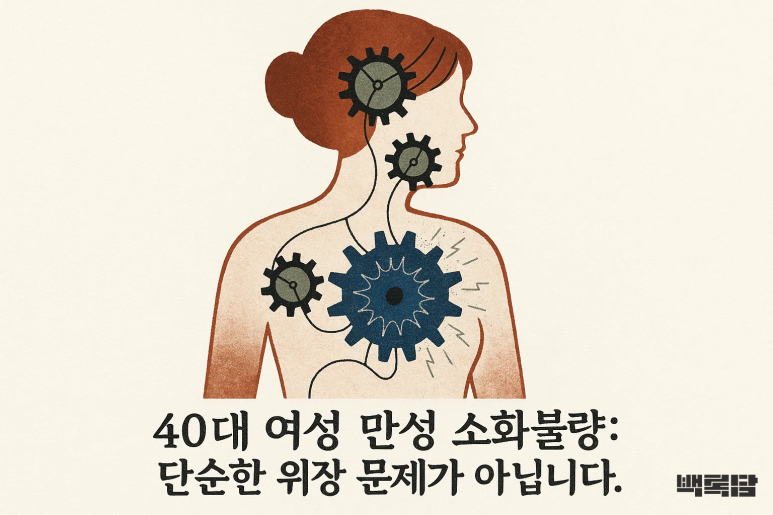
To protect itself, our stomach is wrapped in a sticky and strong ‘mucus protective barrier’ that guards the stomach wall from powerful gastric acid. It is like a tempered glass film for a smartphone.
But what happens if ‘sandpaper’ such as spicy and salty foods, alcohol, coffee, and stress scrapes and wears down this protective barrier little by little every day?
The protective barrier becomes thinner and thinner, and eventually, holes are punctured. The fragile stomach wall, having lost its protective barrier, is directly exposed to the attack of gastric acid, leading to inflammation (heartburn), slowed movement (bloating), and an inability to properly accept food (pain). This is the beginning of chronic gastritis.
Oriental Medicine Perspective
'Barren Land' and 'Unextinguished Embers'
In Oriental medicine, the stomach is compared to ‘healthy soil (土壤)’ which becomes the source of all life. Chronic gastritis is like a state where this soil has been attacked for a long time and has become ‘dry and barren.’
It is a situation where the moisture and nutrients (Jin-yeok/津液) of the soil are lacking, and it even harbors ‘unextinguished embers (stomach heat/胃熱)’ due to stress and bad food.
In such barren land, it is difficult for any seed (food) to take root and grow properly. Therefore, Oriental medicine treatment is not simply about suppressing gastric acid to hide immediate symptoms.
Supplying nutrition and moisture to the ‘barren soil’ (Ja-eum-yang-wi/滋陰養胃) and cooling the ‘unextinguished embers’ (Cheong-yeol/淸熱) to help the stomach regain the strength to create a strong protective barrier on its own. That is the treatment perspective of Oriental medicine, which revives the foundation of the soil.
Lifestyle Management
3 Habits to Rebuild the Stomach's Protective Barrier
Daily efforts can make the thinned protective barrier of the stomach thick again.
- Habit 1: Avoid Irritants
Spicy, salty, and sour foods that directly scrape the stomach wall, as well as coffee, alcohol, and carbonated drinks that promote gastric acid secretion, are the number 1 priority to avoid until the protective barrier is recovered. - Habit 2: Regular Meals
If the fasting period becomes long, high-concentration gastric acid directly irritates the stomach wall. Please keep your stomach comfortable by eating regularly at set times, even in small amounts. - Habit 3: Peace of Mind
Stress is the biggest enemy of the stomach. This is because it disrupts the autonomic nervous system that controls the movement of the stomach. Time spent finding peace of mind through light walks or meditation soon brings peace to the stomach.
Prognosis and Golden Time
On the path from ‘chronic gastritis’ to ‘stomach cancer,’ there is a tendency to take chronic gastritis lightly, calling it ‘a disease that any Korean has.’ However, you must know what lies at the end of this path.
The path where chronic inflammation is repeated can be a dangerous downhill slope leading from ‘atrophic gastritis,’ where the stomach mucosa thins, to ‘intestinal metaplasia,’ where stomach cells change into intestinal cells. And intestinal metaplasia is known to be a strong pre-stage of stomach cancer.
Whether it will remain a simple discomfort or proceed to an irreversible change. That crossroads depends on how seriously you take the signals your stomach is sending right now.
is available.