“My Stomach is Twisting and Diarrhea Won’t Stop” | 30s Office Worker Indigestion & Diarrhea

Table of Contents
“My Stomach is Twisting and Diarrhea Won’t Stop” | 30s Office Worker Indigestion & Diarrhea
Is Recurring Discomfort Just Because of a ‘Sensitive Gut’?
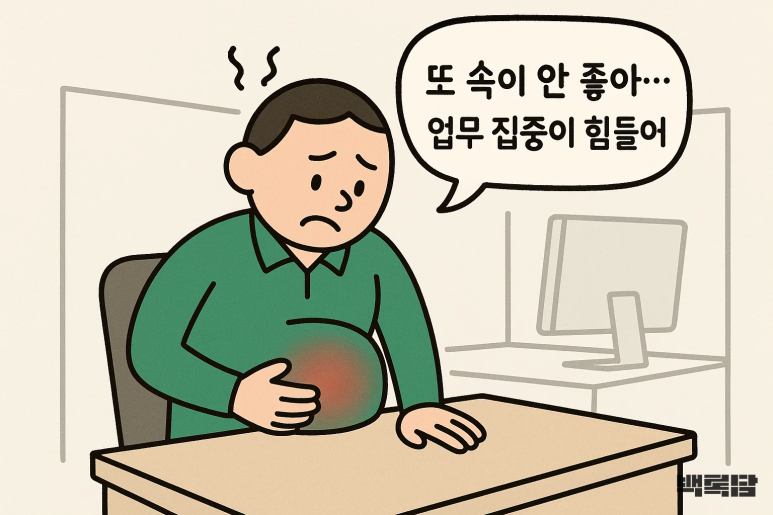
\n\n| \n “When I eat in the morning, my stomach feels bloated and gassy until lunch, so I can’t concentrate on work. If I eat greasy food at a team dinner, my stomach aches immediately and I have to run to the bathroom. Even when I go to the hospital, they say there’s no special abnormality and it’s just stress-related… it’s really frustrating.” \n |
Whenever I hear such stories, I deeply empathize with the patient’s pain.
This is because it’s `not simply a problem needing a digestive aid, but a discomfort where the entire daily life is shaken`.
Many people blame themselves for having a ‘sensitive gut,’ but I suggest exploring the `fundamental principle` together.
`Frequent diarrhea and chronic indigestion are often not just a gut problem, but complex signals sent by our bodies`.
The Complex Link Between Stress, Lifestyle Habits, and Gut Health
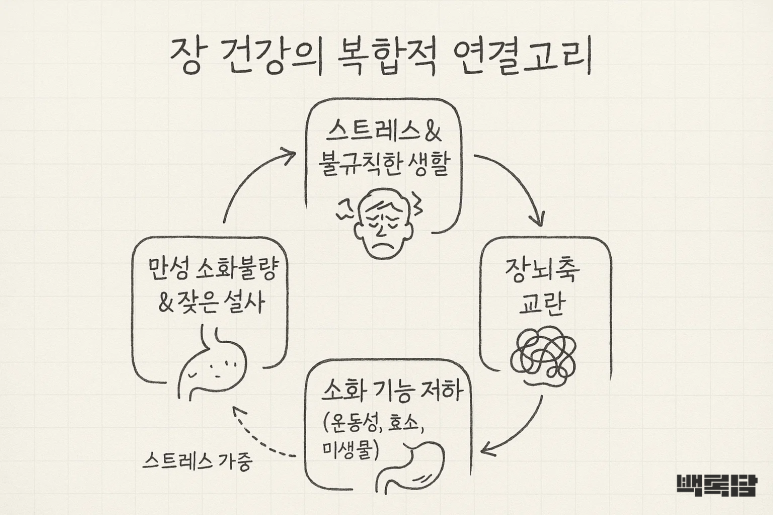
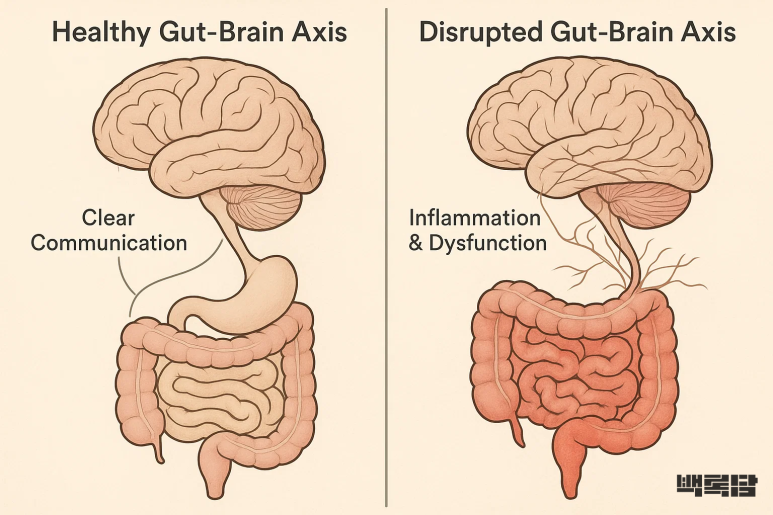
The digestion process of our bodies does not consist of only stomach and gut functions.
The brain and gut communicate closely like `tight friends`.
It’s the so-called `‘Gut-Brain Axis’` concept.
\n\n| \n It can be observed that stress, irregular life, and wrong eating habits appear repeatedly. These factors negatively affect the gut-brain axis and perturb `gut motility, digestive enzyme secretion, and gut microbial balance`. A perturbed gut environment leads to symptoms like indigestion, frequent diarrhea, and stomach ache, and this can eventually show aspects similar to `Irritable Bowel Syndrome`. Therefore, beyond symptom relief, we should aim for `fundamental recovery through improvement of lifestyle habits`. \n |
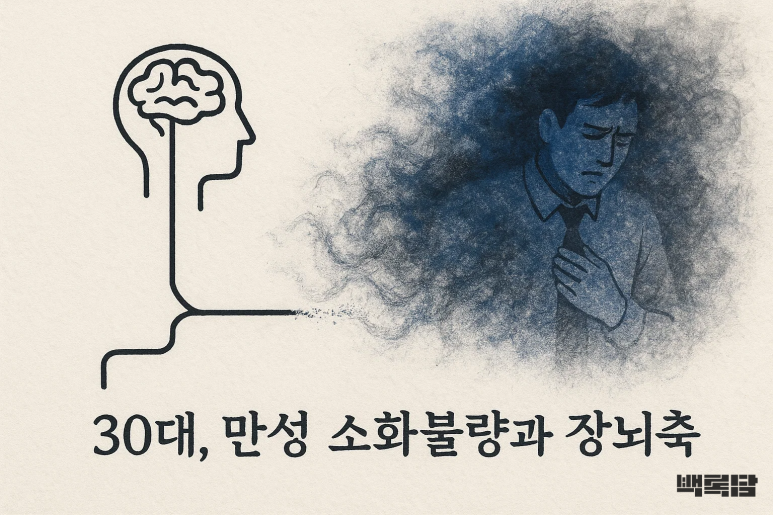
It was the same for Ji-hoon (pseudonym), a 30s office worker I met.
Due to frequent overtime and team dinners, and sleeping in on weekends, his meal times were erratic, and he was always living in tension.
He only thought his ‘stomach was weak,’ but the cause of his indigestion was a complex problem starting from stress and irregular lifestyle habits.
Chronic indigestion and frequent diarrhea that lasted for several years were significantly lowering his quality of life.
\n\n| \n Ji-hoon (pseudonym) was a 32-year-old male office worker who had been suffering from recurring indigestion and diarrhea for over 2 years. Particularly when he was tense or ahead of an important meeting, he experienced urgent diarrhea along with pain as if his stomach was twisting. Through consultation with Ji-hoon, I carefully recorded his meal log, sleep pattern, stress factors, and even his usual emotional state. I judged that a treatment plan encompassing his entire life context was necessary, not just a prescription helping gut function. \n |
Digestive symptoms are thus like a `mirror reflecting our body and mind, and overall life`.
Rather than simply suppressing symptoms, `it is important to understand the essence of why these signals appear.`
The Process of Drawing a ‘Customized Map’ Just for Me
Then how can we solve this complex problem?
I think it’s important to listen to the `‘body story’` of each patient and draw a `‘customized map’` suitable for that story together.
`Improvement of lifestyle habits for indigestion treatment and frequent diarrhea` should vary depending on an individual’s conditions and reactions.
\n\n| \n We can remember small practices in daily life to reduce digestive discomfort. `It is important to eat slowly in small portions frequently and chew food sufficiently.` `It is good to avoid greasy food, spicy food, too cold or hot food for a while and maintain a bland diet.` Also, the habit of lying down immediately after a meal can induce acid reflux or digestion delay, so refrain from it, and light walking can also be helpful. `Sufficient water intake is essential for gut health and especially important to prevent dehydration during diarrhea.` \n |
Along with these efforts, sometimes `herbal medicine` can play a large role in increasing the body’s autonomous recovery power.
Herbal medicine is not simply covering symptoms, but a process of helping `body environment change and constitutional balance recovery`.
Particularly, through the `principles of Shanghanlun and Jingui Yaolue`, we strengthen gastrointestinal function in the long term, increase resistance to stress, and `focus on fundamentally treating chronic indigestion and diarrhea.`
\n\n| \n `If there is severe abdominal pain, or if you see bloody or black stools, or if weight loss is accompanied, it may not be simple indigestion.` `If these symptoms appear, it is important to immediately consult with a medical professional for accurate diagnosis and appropriate treatment.` Be careful not to miss the treatment timing by judging for yourself. \n |
The Journey of Recovery, It’s Okay Not to Walk Alone
The message I want to convey to you who are exhausted from indigestion and diarrhea is clear.
`You are never alone`.
I am also walking this path of recovery together with numerous patients in clinical practice, always being moved and learning from their small changes.
Our bodies have much more `amazing recovery power` than thought.
It just needs the `correct ‘key’ and ‘method’` to awaken that recovery power.
My role is to help find that key together and be a `helper` so your body can regain balance by itself.
Listening to the signals your body is sending now, and from the `effort to interpret the body’s signals`, the true journey of recovery will begin.
Even if it’s not me, `meet a medical team that empathizes`.
I believe that first step will breathe vitality back into your daily life.