My Stomach Feels Like a Ball of Fire! | A 30-Something Office Worker's Chronic Indigestion and Heartburn

Table of Contents
The Voice Behind the Symptoms: What the 'Ball of Fire' Tells Us
Let me illustrate with a case I've seen.
|
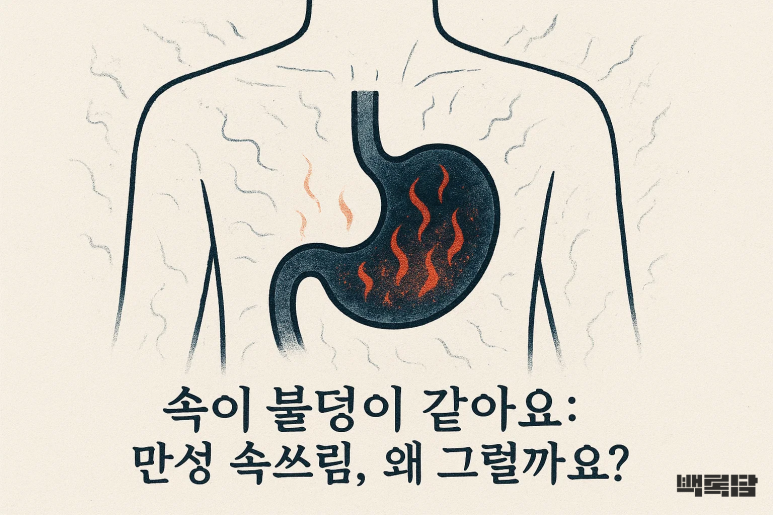
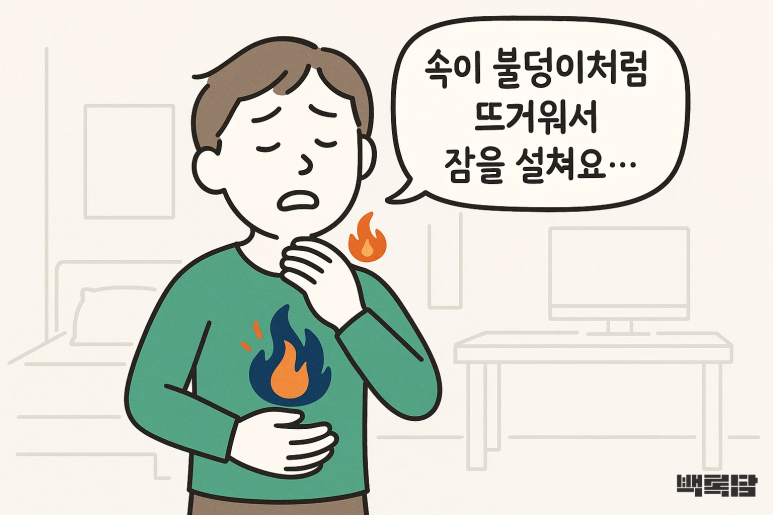
“My stomach feels hot as soon as I wake up, disturbing my sleep. No matter what I eat, my stomach feels heavy and uncomfortable, and when stomach acid comes up, my throat feels like it's burning up.” |
These were the words of Jihoon (pseudonym), a professional in his 30s, when he first came to see me.
Jihoon said he suffered from daily overtime and company dinners, and to relieve stress, he enjoyed stimulating foods and late-night drinking.
Initially, he only experienced occasional stomach discomfort, but at some point, he began to suffer daily from a burning pain in his stomach, along with indigestion and chronic heartburn.
An endoscopy revealed no specific abnormalities beyond mild gastritis, which he said left him even more frustrated.
Jihoon's story was not much different from what I hear from many patients in my clinic.
Often, these symptoms cannot be explained by mere excess stomach acid or lack of digestive enzymes alone.
The body's signal, the sensory expression of feeling like 'my stomach is a ball of fire,' is a clinical clue indicating heat and imbalance originating deep within our body.
As an academic and a clinician, it is crucial to meticulously observe and interpret these clues.
Body Imbalance, Manifesting as 'Hwa' (Fire)
In Traditional Korean Medicine (TKM), symptoms like Jihoon's are not seen merely as stomach problems.
Instead, we emphasize the overall function and harmony of the body.
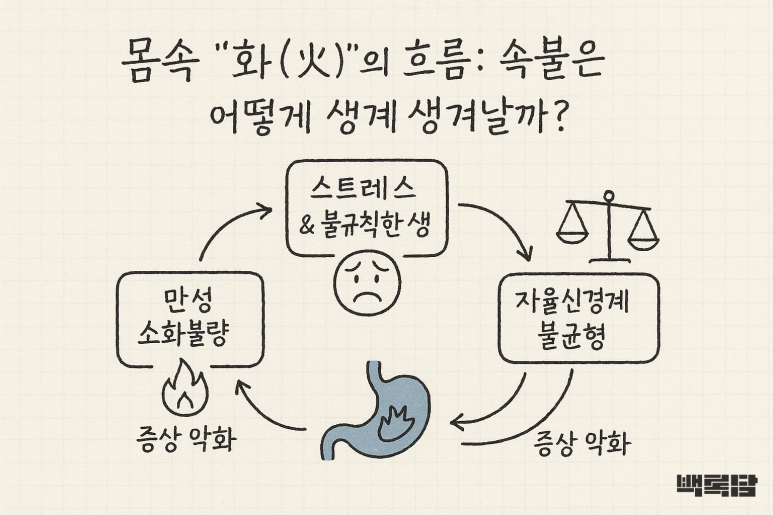
Chronic stress, irregular eating habits, and insufficient sleep are major factors that cause 'Hwa (Fire)' to accumulate in our bodies.
This 'Hwa' is more than just heat; it refers to an unnecessary sensation of heat that obstructs the body's energy flow and impairs the function of internal organs (Jangbu).
Especially in modern individuals, excessive mental stress can affect the autonomic nervous system, leading to reduced gastrointestinal motility and imbalanced gastric acid secretion.
It is well known through modern medical research that there is a close connection between the brain and the gut. Stress can affect gut motility, sensitivity, immune function, and gut microbiota, potentially causing or worsening functional gastrointestinal disorders.
|
The Pathway of Stress and 'Hwa (Fire)' in the Body Excessive stress, irregular lifestyle, and stimulating diets can lead to an imbalance in the body's autonomic nervous system and diminish the body's heat regulation function. This, in turn, can result in reduced gastrointestinal motility, imbalanced gastric acid secretion, and damage to the intestinal lining, ultimately manifesting as chronic indigestion, heartburn, and hot, 'ball of fire'-like symptoms. |
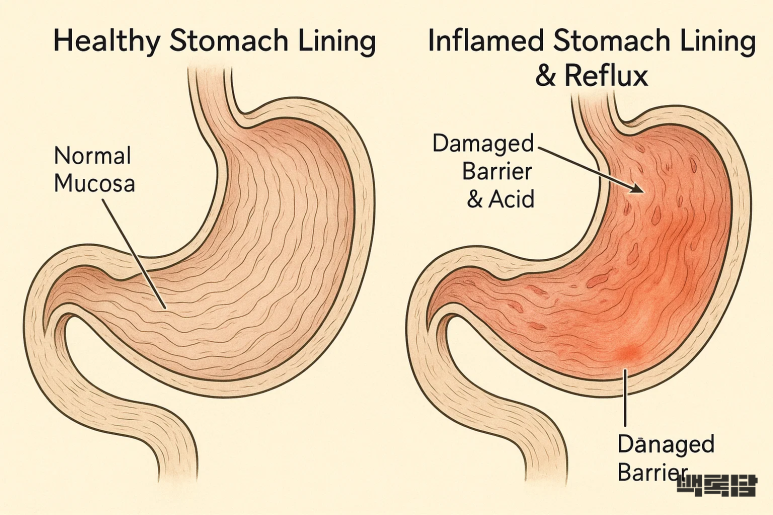
When accumulated 'Hwa' in the body weakens gastrointestinal function and triggers inflammatory responses, it can lead to damage to the stomach lining, acid reflux, and ultimately, 'ball of fire'-like pain.
This is a critical warning sign that can lead to the deterioration of not only gastrointestinal health but also overall systemic health.
Clues in Daily Life: Where Does My 'Inner Fire' Come From?
So, where does my 'inner fire' come from?
The answer to this question lies hidden in everyone's daily lives.
Frequent overeating and binge eating, eating too quickly, and excessive consumption of spicy, salty, and greasy foods place a significant burden on the stomach.
Furthermore, lack of sleep due to late-night work and smartphone use reduces the body's recovery capacity and increases stress hormones.
Irregular meal times and the habit of lying down immediately after eating are also important factors that negatively affect digestive function.
|
Hidden Habits that Fuel Your 'Inner Fire' Surprisingly, many people overlook habits such as frequently drinking hot coffee or tea, excessive alcohol consumption, or smoking to relieve stress. These habits can be major causes of worsening heartburn. Moreover, wearing tight clothing or belts can increase abdominal pressure and aggravate reflux esophagitis, so it's advisable to pay close attention to these. |
Even without my intervention, meticulously observing your own lifestyle habits and identifying the harmful clues is the first step towards recovery.
After all, our bodies always send us honest signals.
The Journey to Recovery: An Integrated Approach for You
The path to overcoming this chronic discomfort extends beyond simple medication.
I would describe this as 'a process of transforming the body's entire environment'.
First, 'lifestyle improvement' is paramount.
Regular meals, reducing gastrointestinal burden through smaller portions, stress management, and ensuring sufficient sleep are fundamental.
Specifically, it's best to finish dinner at least 3 hours before bedtime and focus on easily digestible, bland foods.
Second, an 'integrated approach combining TKM insights' is necessary.
Herbal medicine prescriptions, tailored to each patient's constitution and symptom patterns to correct bodily imbalances, go beyond merely suppressing symptoms.
The goal is to alleviate the accumulated 'Hwa' within the body, strengthen gastrointestinal function, and boost overall immunity and recovery capabilities.
This herbal treatment is not just medicine; it can be a 'personalized story' and a 'companion on your journey to recovery' tailored to your body.
|
Avoid Hasty Self-Diagnosis and Treatment It can be dangerous to indiscriminately take medication or attempt self-treatment based solely on information from the internet or the experiences of others. It is crucial to consult with a professional to establish an accurate diagnosis and treatment plan suitable for you. If symptoms are severe or persistent, there is a possibility of other underlying conditions, so you must visit a medical institution. |
I don't just look at the symptoms; I focus on identifying and resolving the fundamental bodily imbalances that caused them.
The body possesses an incredible power to heal itself.
My role, then, is to guide that power along the correct path and provide the necessary resources so it can be properly unleashed.
Even if it's not me, I sincerely hope that you, the reader, can find a healthcare professional who meticulously examines your entire body, enabling you to become the agent of your own recovery.