
When You Have a Headache and Feel Nauseous | Incheon Headache & Indigestion

Table of Contents
Hello. This is Baekrokdam Korean Medicine Clinic.
When your head hurts and you feel nauseous, where should treatment begin? There are days when your head hurts, you feel nauseous, and you have indigestion. It might just be due to simple fatigue, but if it recurs, it becomes a bit concerning. Even if you visit a hospital asking, 'What's the problem here?', it's rare to get a clear-cut answer.
However, it's not important that these symptoms 'appear together.' Understanding which symptom appeared first, and how that progression unfolded – identifying this sequence is the true starting point of treatment.
1. The sequence in which symptoms began is key
What if you first felt nauseous, and then your head started throbbing a few days later? That could mean an abnormal signal from the stomach affected the brain. This is a progression where a problem starts in the stomach, disrupts the autonomic nervous system, and then propagates to the brain.
Conversely, what if your head hurt first—and then your appetite disappeared? This is a typical case where a central migraine or a hyperactive sympathetic nervous system suppressed gastrointestinal function. Whether the headache came first, or the gastrointestinal symptoms. Just by knowing this sequence, you can determine which system to treat first.
2. The Brain and Gut are a Single Circuit
The autonomic nervous system, especially the vagus nerve, is directly connected from the brainstem to the gastrointestinal tract. So, when you experience a lot of stress or the sympathetic nervous system becomes overactive, the brain becomes excited, and the stomach also stops functioning. We often perceive this as 'a day with indigestion.'
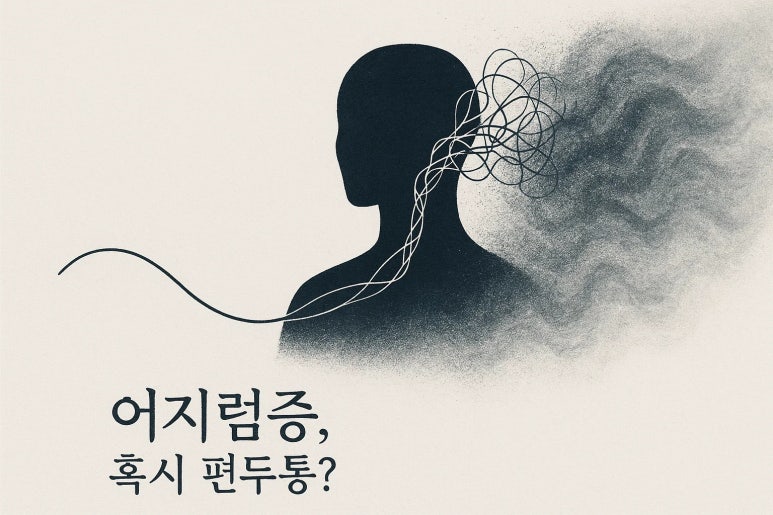
But in reality, the circuit connecting the brain and the gut – specifically, the gut-brain axis – has become tangled. Therefore, on days when both your head and stomach feel unwell, you must first acknowledge that they are influencing each other. It's not just a simple case of simultaneous symptoms, but rather a symptom of a single circuit.
3. In Korean Medicine, We Determine the 'Sequence' of Treatment
In Korean medicine, when addressing an illness, we always ask: “Where did the illness begin? What should be resolved first for the whole system to return to normal?” For example, if the stomach is blocked first and *qi* (energy) counterflows upwards, that energy surges to the head, causing headaches. In such cases, instead of addressing the head first, we must stabilize the stomach.
Conversely, in cases like Liver Qi Stagnation, where rising *qi* suppresses the stomach, the *qi* must first be circulated for the stomach to function properly again. This is precisely the principle of treatment priority (先後). Instead of trying to address everything at once, it's a method of finding and resolving the first link in the chain of the illness.
4. Key Points to Confirm During Consultation
So, in the clinic, these questions are extremely important:
“When did it start?”
“What was the first discomfort you experienced?”
“What happened next?”
“What is its relation to diet, sleep, and stress?”
This isn't just a simple symptom check; it's the process of reading the map of the illness. Knowing the direction guides the treatment. If you try to address all symptoms simultaneously just because there are many, recovery will actually be delayed. Among those many symptoms, the one that appeared first is the most crucial. Whether it's the stomach or the head, identifying the starting point reveals the clue, and only by unraveling it link by link can treatment be effective.
Illnesses are interconnected, and treatment must proceed in sequence for recovery.
#IncheonHeadache #IncheonIndigestion