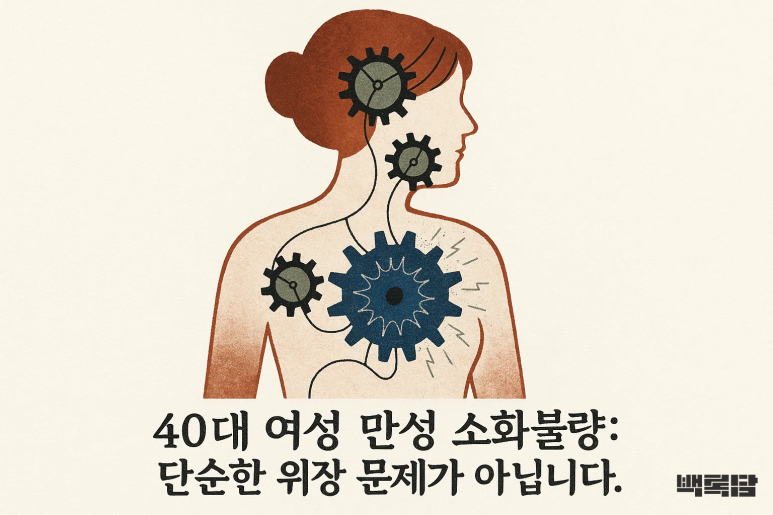

Chronic Epigastric Pain and Discomfort, Why You Should Check the 'Small Intestine' Instead of the Stomach (SIBO Correlation) | Incheon Epigastric Pain

Table of Contents
Could this be a long-standing concern of yours? You may have undergone gastroscopies several times because of this unpleasant feeling that worsens especially after meals and invariably occurs whenever you are stressed. However, the results were always just 'nervous' or 'mild gastritis.' Even after taking prescribed gastrointestinal medication, the relief is only temporary, and the frustration of 'why am I the only one suffering like this' only grows.
While everyone is looking only at the 'stomach,' have you ever considered that the real problem might be happening right below it, in the 'small intestine'?
Hello
I am Choi Yeon-seung, an Oriental Medicine Doctor who, for 15 years, has been fundamentally treating the causes of epigastric stuffiness that cannot be explained by endoscopic examinations, finding the answers in 'SIBO (Small Intestinal Bacterial Overgrowth)' and 'Damjeok (phlegm accumulation)'.
If you read this post to the end today, you will discover the true culprit behind that tedious feeling of tightness that has been bothering you. And I promise that you will find a new solution that no longer relies solely on gastrointestinal medication.
Is the culprit really the 'stomach'? Shift your gaze downward
It is natural to first suspect the 'stomach' when the solar plexus feels tight. In fact, gastritis, gastric ulcers, and reflux esophagitis are indeed representative causes that induce solar plexus pain and tightness. However, if you are in the following situation, it is now necessary to shift your gaze a bit further down.
- You have heard the opinion that 'there are no particular abnormalities' across multiple gastroscopy examinations.
- You were diagnosed by a doctor with 'nervous gastritis' or 'functional dyspepsia'.
- The feeling of tightness is not relieved even after taking prescribed medications such as acid suppressants or gastrointestinal motility enhancers.
If gastrointestinal medications are ineffective and an endoscopy shows everything is clear, there is a high possibility that the 'stomach' is not the culprit. Although the crime scene occurred near the epigastrium (stomach), the real culprit may be hiding on the floor below, in the 'upper small intestine (duodenum, jejunum)'.
Invisible pressure, 'small intestine gas,' presses on the epigastrium (feat. SIBO)
Even what can't be seen through endoscopy and can't be solved with medication—the true culprit behind that chest tightness is none other than 'gas that originated in the small intestine.' And the fundamental cause creating this gas is 'SIBO (Small Intestinal Bacterial Overgrowth).'
"But isn't it strange? The problem is in the small intestine, so why do we feel the discomfort in the epigastric area?"
'A balloon inflated on the lower floor'—imagine this and you can understand it easily. In a 2-story house, instead of the 2nd floor (upper), imagine a giant balloon (gas) being inflated on the 1st floor (small intestine) floor. As the balloon grows larger, the structure that is both the ceiling of the 1st floor and the floor of the 2nd floor (above, the diaphragm) gets powerfully pressed from below. The problem actually starts on the 1st floor, but the discomfort and pressure are felt on the 2nd floor.
The gas generated in the upper small intestine due to SIBO serves exactly this 'balloon' role. The pressure created by this gas pushes the stomach upward from below, causing a tight, blocked sensation as if something is always caught in the epigastric area. In addition, since it interferes with the pathway for food to pass from the stomach to the small intestine, symptoms such as 'early satiety' where the stomach feels full after eating only a little, or worsening chest tightness after meals, occur. In the end, the chest tightness you felt was not the 'stomach' screaming, but rather the painful groan of the 'stomach' being crushed by the gas pressure from the lower-level small intestine.
Traditional Korean Medicine Diagnosis: The Reality of 'Damjeok (痰積)'
The 'invisible pressure on the lower floor' explained previously. In fact, this phenomenon exactly coincides with a very important pathological concept in Traditional Korean Medicine, which has thousands of years of history. That is 'Damjeok (痰積)'.
The sensation patients complain about, such as "It feels like there is a stone at the end of my sternum" or "It always feels tightly blocked," is a representative symptom of 'Damjeok,' where hardened tissue is confirmed through abdominal examination (Bokjin).
Then, what is the reality of Damjeok? At our clinic, we do not view Damjeok simply as a 'hardened lump.' Damjeok is,
- chronic gas pressure caused by SIBO,
- inflammation of the intestinal mucosa induced by it, and
- a pathological state combined with sticky waste products (Dam-eum) caused by inflammation.
In other words, SIBO is a very important clue that allows us to look at the phenomenon called 'Dam-jeok' through the eyes of modern science and measure it with the objective value of gas volume.
Finding the root of the problem
In conclusion, the tightness in your solar plexus was not a malfunction of the stomach (2nd floor) itself, but a signal of pain sent as the 'gas balloon (SIBO)' in the small intestine (1st floor) below pressed against the upper floor. It is as if you have been knocking on the door of the wrong floor for a long time.
Only when you properly locate the site of the real problem does the correct solution begin to appear. Now we know that the site of the problem is the 'small intestine.' Shall we take one step deeper?
What caused the gas balloon to form in the 'lower floor' known as the small intestine in the first place? Surprisingly, the starting point of all problems returns to the 'stomach.' In many cases, all the tragedy begins with the collapse of the stomach's 'gastric acid defense wall.'
Your long-standing frustration, the end is now beginning to come into sight.
#SIBO #EpigastricPain #EpigastricTightness