Chronic Indigestion: Why Medicine Only Provides Temporary Relief | Incheon Indigestion

Table of Contents
Chronic Indigestion: Why Medication Only Provides Temporary Relief
|
“Doctor, I’m at my wit’s end. After dinner, my stomach feels so bloated and uncomfortable that it’s hard to sleep. I’ve tried every good digestive aid on the market, but I only feel a little better when I take the medicine, and then the next day it’s the same again. What could be the problem?” |
Mr. C, a financial professional in his 40s, constantly complained of fatigue and a heavy, bloated feeling in his stomach. He said he suffered from indigestion even without eating particularly greasy foods or overeating. Especially on days with high work stress, his symptoms worsened. He constantly reached for products like Festal or Gelfos due to frequent burping and a persistent, oppressive discomfort.
If your indigestion is simply due to overeating, digestive aids can be an excellent solution. However, if, like Mr. C, medication only provides temporary relief, or symptoms recur without any particular dietary issues, the problem isn't simply a lack of digestive enzymes or excessive stomach acid. It's due to 'decreased gastrointestinal motility.'
|
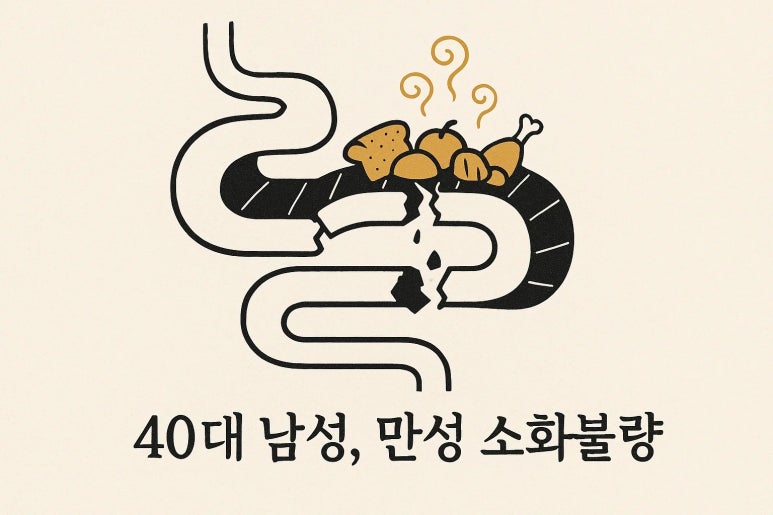
Imagine your stomach as a 'broken conveyor belt that moves food to the next stage.' A healthy stomach properly breaks down food and quickly moves it to the small intestine. However, chronic stress or an irregular lifestyle can slow down or even completely stop this conveyor belt. This is consistent with 'Spleen-Stomach Qi Deficiency' in traditional Korean medicine or 'Gastric Emptying Delay' in modern medicine. |
The 'Accelerator Pedal' of Digestion: The Secret of the Parasympathetic Nervous System
So, what is the 'broken traffic light' that regulates gastrointestinal motility? It is the **autonomic nervous system**. The sympathetic nervous system, activated when you are tense or stressed, switches on a 'survival mode' to prepare for 'danger' and suppresses digestive functions. Conversely, the parasympathetic nervous system, activated during rest, acts as an 'accelerator pedal' that promotes gastrointestinal tract movement. Modern people suffering from chronic stress often have impaired function of this parasympathetic nervous system.
This is like constantly pressing the accelerator while the brake is engaged. With the sympathetic nervous system's 'brake' always on, and the parasympathetic nervous system's 'accelerator pedal' not working, the digestive tract inevitably moves sluggishly. As a result, food remains in the stomach for longer, leading to frequent burping, discomfort, and a 'full' sensation. This is the essence of what we call 'functional dyspepsia.'
|
💡 Your indigestion might be a problem of your 'nerves,' not just your 'stomach.' If you, too, constantly rely on digestive aids but your symptoms persist, it's time to address the stress and anxiety that are putting the brakes on your body and mind, rather than solely depending on medication. |
Revitalize Your Stomach's Intrinsic Movement
Chronic indigestion is not just a nuisance to be dismissed. It's a sign that our body's most fundamental biological rhythm—the 'digestive' system—has broken down. Digestive aids are merely a temporary fix, like changing a signpost on a congested road; they don't clear the road itself. Therefore, the fundamental solution lies not in relying on medication, but in resting your body and mind to restore the function of the parasympathetic nervous system, which is responsible for gastrointestinal motility.
If you want to escape the suffering of chronic indigestion, don't just focus on food or medication. Efforts are needed to revitalize 'gastrointestinal motility' through adequate sleep, rest, and regular exercise. Your stomach has the power to move on its own. Now is the time to regain that power.