Recovery After C-Section, Why Does It Feel More Difficult? | Incheon Postpartum Herbal Medicine

Recovery after C-section, why does it feel more difficult?
The mothers I meet in the consultation room, especially those who met their babies through C-section, express similar concerns.
|
"My friend who had a natural birth seems to recover quickly, but my afterpains last too long and my body feels as heavy as a thousand pounds. Is it originally like this because it was surgery?" |
Within this question lies a deep exhaustion that others do not know.
|
[CASE] Recovery Record of a Patient in Her 30s A certain mother in her mid-30s, even after 2 weeks have passed since cesarean section, postpartum swellingdoesn't go down at all, and every night the throbbing at the surgical site and C-section afterpainsoften caused loss of sleep. prescribed at the hospital painkillersShe relied on painkillers prescribed at the hospital, but because the pain only stopped momentarily and she did not feel her body was recovering, she came to visit. Compared to natural childbirth, the recovery speed was in a state of being noticeably slower. |
Many people think of recovery after a C-section as two independent tasks: 'postpartum care' and 'post-surgical wound management'.
Therefore, people often focus on supplementing their energy by eating healthy foods and disinfecting the surgical site to prevent infection.
|
[What we are missing] However, right here lies an important trap that we are missing. If recovery after a C-section were simply a matter of supplementing energy and healing wounds, the body should recover smoothly with sufficient rest and nutritional supply alone. However, pain that cannot be completely controlled even with painkillers and slow reduction of swelling suggest that the essence of the problem lies beyond visible wounds or fatigue. It is precisely the 'invisible traces of surgery',postpartum Eohyeol (瘀血)that is the cause. |
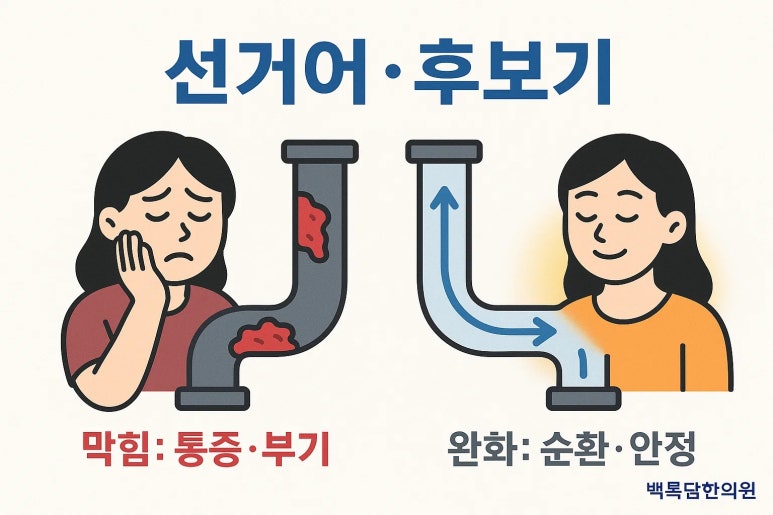
To understand this complex situation, let me use an analogy for a moment.
Let's think of our body as 'a house that has just finished major construction'. Childbirth is a major construction project that completes the main framework of the house.
However, a C-section is like having 'unexpected internal plumbing work' added to this.
At this time, the micro-bleeding at the surgical site and the difficulty of normal lochia discharge mix to create residue called 'Eohyeol' (blood stasis).
This Eohyeol obstructs the smooth circulation of qi and blood, uterine atonyThis causes uterine subinvolution and makes the supply of nutrients for recovery slower.
|
[Wisdom of Korean Medicine: 先去瘀 後補氣血] This aligns exactly with the wisdom of Korean medicine passed down from hundreds of years ago. In the 《Dongui Bogam》, the 1 principle of postpartum care is emphasized as 'Seon-geo-eo hu-bo-gi-hyeol (先去瘀 後補氣血)', meaning 'first remove blood stasis, and then supplement qi and blood.' This is the insight that if you only provide good things without clearing away the 'residue' known as blood stasis, it may instead hinder circulation and slow down recovery.Lochia discharge herbal medicineThis is why it plays a crucial role in taking the first step toward recovery, going beyond simply helping with uterine contractions. |
Ultimately, the severe afterpains and slow recovery the mother experienced were, in effect, distress signals sent by the blood stasis remaining in the body's 'plumbing'.
If this blood stasis is not resolved, no matter how good the postpartum care herbal medicineeven if you take it, it is difficult for the effect to be fully delivered.
Perhaps in your postpartum care, while overlooking the invisible internal problems,
are you focusing only on visible wounds and replenishing energy?
|
[A new question that changes the perspective of recovery] Through this new perspective, we can now lead the journey of recovery more proactively. Beyond simply asking an expert, "Which nutritional supplement is good?", you have gained the power to ask a more fundamental question: "How can I effectively discharge the blood stasis that hinders my body's recovery and fill that space with healthy qi and blood?" This is the beginning of true change. |