
Chest Pain, Dry Cough, Globus Sensation… Everything About Reflux Esophagitis (From Symptoms to Management)

Table of Contents
- Why Is It More Than Just Heartburn? Refluxed Stomach Acid Attacks the Entire Body
- 1. Typical Digestive Symptoms
- 2. ENT Symptoms Appearing in the Throat and Nose
- 3. Systemic Symptoms Appearing Throughout the Body
- How Does Korean Medicine View This 'Functional Problem,' or the Fundamental Causes of Stomach Acid Reflux?
- The cause is found in the body's overall 'imbalance,' with two primary factors standing out.
- 5 Golden Rules to Prevent Recurrence
- 1. Diet Management: Be Clear on What to Avoid and What to Include
- 2. Posture Management: Make 'Gravity' Your Ally
- 3. Abdominal Pressure Management: Reduce 'Stomach Pressure'
- 4. Stress Management: Stabilize the 'Autonomic Nervous System'
- 5. Hydration: Drink Water 'Smartly'
- Why You Shouldn't Dismiss It as 'Mere Indigestion'
"My chest felt like it was burning, so I even had a heart exam, but the results were normal."
"I'm so exhausted by a dry cough I can't explain and phlegm that keeps forming no matter how much I clear my throat."
"A foreign body sensation in my throat, like something is stuck, and even ENT medication only provides temporary relief."
Are you perhaps struggling with these frustrating symptoms, visiting multiple hospitals for a long time?
Surprisingly, the root of all these symptoms might be just one condition: 'gastroesophageal reflux disease (GERD)'.
The problem is that many people only think of GERD as a simple 'heartburn' condition and overlook the lifestyle habits that are the true cause.
Hello, I'm Dr. Choi Yeon-seung, director of Baengnokdam Korean Medicine Clinic, where I have treated countless GERD patients for 15 years. In this post, I will thoroughly explain why GERD causes such a wide range of symptoms, and even the essential lifestyle management methods to regain a comfortable daily life without medication.
Why Is It More Than Just Heartburn? Refluxed Stomach Acid Attacks the Entire Body
The main culprit in GERD is 'stomach acid (胃酸)'. The stomach acid inside us is actually as powerful as 'hydrochloric acid,' capable of dissolving even metal. Normally, the strong stomach lining effectively protects against stomach acid, but problems arise when this acid begins to reflux up the esophagus.
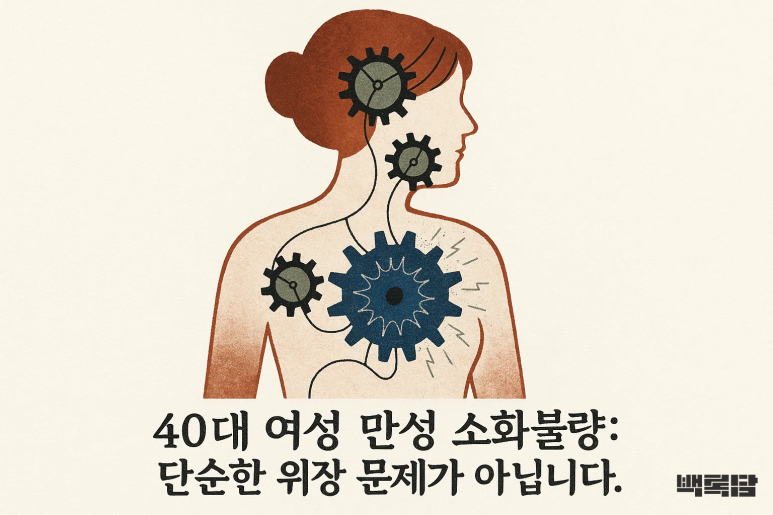
Like an out-of-control blaze, refluxed stomach acid attacks the entire body, extending beyond the esophagus to the throat, vocal cords, nose, and even the back, creating various symptoms. Check if any of the following symptoms appearing in your body might be due to GERD.
1. Typical Digestive Symptoms
- Chest pain and tightness: A burning sensation in the chest.
- Epigastric pain: A feeling of tightness and discomfort in the pit of the stomach.
- Indigestion, abdominal distension: Sensation of food not going down.
- Nausea, vomiting: Nausea or vomiting in severe cases.
- Bitter or metallic taste in the mouth.
2. ENT Symptoms Appearing in the Throat and Nose
- Foreign body sensation in the throat: A feeling of phlegm or something stuck in the throat.
- Chronic cough, phlegm: Persistent dry cough without clear cause.
- Hoarseness, sore throat: Caused by stomach acid irritating the vocal cords.
- Laryngitis, throat tightness: A constricted feeling in the throat.
- Nasal congestion, nasal odor: Refluxed stomach acid irritating the back of the nose.
3. Systemic Symptoms Appearing Throughout the Body
- Back pain, burning sensation in the back: Occurs due to the connection between stomach nerves and the back.
- Headaches: Nervous headaches that appear alongside indigestion.
- Unexplained palpitations, anxiety.
- Rarely, skin hives reactions.
Many people undergo endoscopy for these symptoms, but often receive results indicating 'mild esophagitis' or 'no abnormalities.' This is because 'functional issues' often begin before severe damage occurs to the esophageal mucosa.
How Does Korean Medicine View This 'Functional Problem,' or the Fundamental Causes of Stomach Acid Reflux?
While Western medicine focuses on controlling immediate symptoms through acid-suppressing drugs, Korean medicine takes a step further and asks a fundamental question:
"Why does my stomach acid keep refluxing, unlike in healthy individuals?"
The cause is found in the body's overall 'imbalance,' with two primary factors standing out.
1. Dam-eum (痰飮) and Dam-jeok (痰積): Metabolic waste creating the 'path' for reflux
The body's vital energy (Qi) naturally flows downwards, like water, from the stomach. However, when undigested food waste accumulates in the stomach due to poor eating habits, it transforms into a sticky substance called 'Dam-eum (痰飮).' If Dam-eum persists and hardens, it becomes 'Dam-jeok (痰積),' which, like grease clogging a drain, obstructs the normal flow of vital energy in the stomach. With the downward path blocked, an 'environment' is created where stomach acid and food inevitably reflux upwards.
2. Gan-gi-ul-gyeon (肝氣鬱結): Stress Attacking the Stomach
In Korean medicine, the 'Liver (肝)' is responsible for circulating vital energy (Qi) throughout the body and regulating emotions. Excessive stress can lead to a state of 'Gan-gi-ul-gyeon,' where the Liver's vital energy becomes stagnant. The problem is that this stagnant Liver Qi then attacks the stomach, its closest organ. This phenomenon, also known as 'Gan-gi-beom-wi (肝氣犯胃),' is akin to a stressed-out boss badgering an innocent subordinate.
Even if the stomach wants to function normally, the Liver's attack causes functional abnormalities, ultimately leading to stomach acid reflux. Cases where palpitations or chest tightness appear alongside indigestion can fall into this category.
Thus, Korean medicine aims not merely to suppress stomach acid, but to create a 'healthy environment' where stomach acid does not need to reflux, by eliminating metabolic waste from the body and correcting organ imbalances caused by stress.
5 Golden Rules to Prevent Recurrence
The key to treating GERD is not 'medication' but 'habits.' No matter how good the medicine, repeatedly engaging in habits that cause stomach acid to reflux daily is like pouring water into a bottomless pit. Here are 5 golden rules you must follow starting today.
1. Diet Management: Be Clear on What to Avoid and What to Include
[Absolutely avoid] Alcohol, tobacco, coffee (caffeine), carbonated drinks that weaken the sphincter, highly acidic fruits (such as lemons) that directly irritate stomach acid, and greasy foods are major culprits in worsening symptoms. Milk and yogurt may also not suit everyone. Consuming these harmful foods on an empty stomach is especially detrimental.
[Embrace] It is best to base your diet on foods that are less irritating and protect the stomach lining, such as porridge, soft rice, and low-acid fruits like bananas.
2. Posture Management: Make 'Gravity' Your Ally
[After meals] Do not lie down for at least 2-3 hours after eating. Gravity is your strongest ally in preventing stomach acid reflux.
[During sleep] It is best to lie on your left side. Due to the anatomical structure of our stomach, it is most difficult for stomach acid to reflux into the esophagus when lying on the left side.
3. Abdominal Pressure Management: Reduce 'Stomach Pressure'
When abdominal pressure increases, stomach acid is more likely to reflux. Avoid tight clothing and wear comfortable waistbands. Avoid exercises that increase abdominal pressure, such as sit-ups, and opt for light walks or stretching instead.
4. Stress Management: Stabilize the 'Autonomic Nervous System'
Stress is an invisible enemy that increases stomach acid secretion and weakens the esophageal sphincter. Just 5 minutes of deep, slow breathing before bed to release daily tension can be immensely helpful.
5. Hydration: Drink Water 'Smartly'
The timing of water intake is also important. Drinking too much water during meals can dilute stomach acid, slow down digestion, and increase stomach volume, potentially causing reflux. It is best to drink plenty of lukewarm water outside of meal times.
Why You Shouldn't Dismiss It as 'Mere Indigestion'
It is most dangerous to dismiss GERD as simple indigestion and neglect it. Repeated exposure of the esophageal mucosa to strong stomach acid can lead to 'Barrett's esophagus,' where the cells themselves transform, which can become a very serious stage increasing the risk of esophageal cancer.
Many people often just manage their symptoms with digestive aids or antacids as they arise. However, this is like a dam leaking water, and instead of plugging the hole, merely wiping away the spilled water. Medication only temporarily masks symptoms and does not address the fundamental causes of stomach acid reflux (weakened sphincter, impaired stomach function).
The 'golden time' for GERD treatment is before symptoms become chronic, while our body still has the strength to recover on its own. Only by correcting early lifestyle habits and initiating treatment that addresses the fundamental cause can you break the cycle of recurrence and hope for complete recovery.
Don't dismiss it any longer with 'it'll pass.' It's time to listen to the SOS signals your body is sending right now.
#GERD