Dampness Accumulation Disorder - What Exactly Is It? (Core Principles Explained by a Korean Medicine Doctor) | Incheon Dampness Accumulation Disorder

Table of Contents
"I've had an upper endoscopy, ultrasound, CT scan done... but all the hospitals keep repeating the same words: 'nervous' or 'functional.'"
"They say everything looks clean on the tests, so why does my belly feel hard as a rock and always bloated?"
"It's not just that my digestion doesn't work—I also have headaches and dizziness. Can it really be that nothing is wrong with me?"
Have you been suffering in this kind of confusion and frustration for a long time?
Hello, I am Dr. Choi Yeonseung, a Korean medicine doctor who has been diagnosing and treating the 'true cause'—'damsheok'—in countless patients with 'unexplained' digestive disorders for the past 15 years.
There is a 'real problem' that is clearly tormenting your body, even though it doesn't show up on tests. It is 'damsheok disease,' a condition in which the functions of the entire digestive system—encompassing the stomach, small intestine, and large intestine—become rigid and stiffened.
If you read this article all the way through today, you will no longer need to feel frustrated. You will clearly understand what your painful symptoms really are—the 'true identity' of 'damsheok disease,' why it couldn't be detected through testing, and its fundamental principles.
Damsheok Syndrome: The Digestive Organs That Have Lost 'Movement' and Become Rigid
Many people mistakenly think that 'damsheok' means a disease where stone-like lumps actually form in the stomach.
But damsheok syndrome is not referring to such anatomical changes.
Rather, it refers to the 'functional' state in which repeated indigestion, poor eating habits, and chronic stress accumulate, causing the entire digestive system—stomach, small intestine, and large intestine—to lose their functions and become hard and stiff.
The key point is that this is a state of 'functional rigidity' in which the muscles and fascia surrounding the digestive tract become chronically and excessively tense, losing their original soft elasticity.
The easiest analogy is an 'old rubber band.'
A new rubber band is soft and highly elastic—it snaps right back when you pull and release it. A healthy digestive system works the same way. When food enters, it actively expands and contracts, vigorously performing peristaltic movements.
But what happens when a rubber band is left under constant stress or in a too-cold place for a long time? It loses its elasticity and hardens stiffly. Even a slight pull might make it snap as if it would break.
Damsheok syndrome refers precisely to this state where our digestive muscles have lost their elasticity and become hard and stiff.
Since the stomach doesn't function properly, food doesn't go down, gas builds up, and you feel a rock-like heaviness in the pit of your stomach.Why Can't Gastroscopy or Colonoscopy Detect It?Many of you reading this must have felt devastated receiving a 'normal' endoscopy result.
"I'm in so much pain and agony, yet they say there's nothing wrong. Maybe I'm just being sensitive, or faking it?"—you may have had such self-blaming thoughts.
But there is absolutely no need for that.
The reason is very simple. It is a problem in an area that endoscopy 'cannot see.'
Endoscopy is like a camera looking at the 'interior walls' of a house.
It is an excellent and precise test for checking whether the wallpaper is torn (ulcer), whether mold has grown (inflammation), or whether small bumps (polyps) have formed.
However, damsheok syndrome is not a problem with the wallpaper (mucosa).
It is a problem with the concrete wall (muscle layer and outer wall) hidden behind the wallpaper becoming stiff and hard, and the entire house's plumbing (digestive function) not working properly.
With an endoscope camera, you can see the inner surface of the digestive tract, but there is no way to check how stiffly the outer muscles have hardened or how sluggish their movements have become.
This is
This is the core of the uncomfortable truth: 'the tests are normal, but I'm in pain.'
So, does this hardened digestive organ only cause indigestion?
Unfortunately, the problem doesn't stop here.
Headaches, dizziness, anxiety… The root of systemic symptoms: the 'Gut-Brain Axis'
"Why does my head hurt and my shoulders become stiff even though it's just digestion that's not working?" "Why do I feel anxious for no reason and my heart races?"
Many of you may have felt greater distress from these complex symptoms.
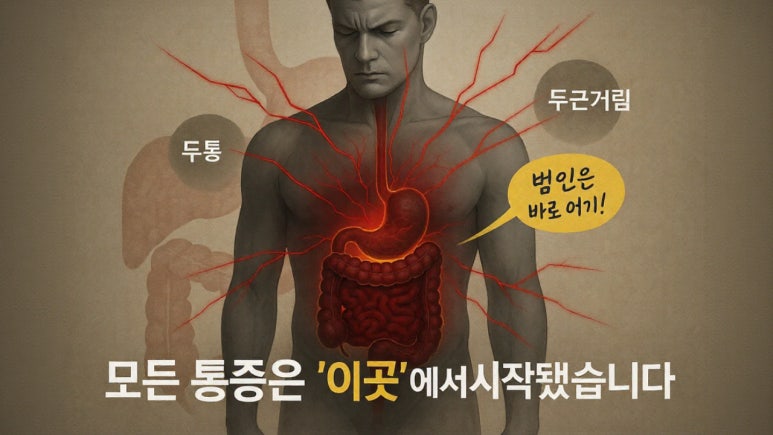
This is because the 'toxins' produced by the hardened digestive organs no longer stay inside the intestines alone.
In intestines with reduced function and severe blockage, food decay generates large amounts of inflammatory substances and toxins.
These toxins break through the weakened intestinal wall (leaky gut) and begin spreading throughout the body via blood vessels and lymph.
Most crucially, these toxins directly affect our brain function by traveling along a neural highway called the 'Gut-Brain Axis.'
This is the scientific reason why the following systemic symptoms appear when digestion isn't working properly.
- Muzzy or painful head, dizziness (Brain fog)
- Feeling anxious for no reason, heart palpitations
- Chronic fatigue that doesn't go away even after sleep
- Stiffness in the back of the neck and shoulders like a stone (Damdammi)
Therefore, Damjeok Syndrome should be understood not as a simple gastrointestinal disease, but as a 'systemic disease' that makes the entire body sick.
When you know the cause, the path forward becomes clear
By now, you may understand that your long-standing suffering could be a disease with a clear cause called 'Damjeok Syndrome,' rather than a vague diagnosis of 'nervousness.'
Understanding the cause is the most important first step in treatment.
Today, we looked into the 'true nature' of damjeok (stagnation). So how can we resolve this accumulated stagnation and make the hardened digestive organs soft again?
We hope to cover those specific treatment methods and lifestyle management approaches in detail when we have the opportunity.
Don't be frustrated anymore. When you find the exact cause, there is always a way forward.
#DamjeokSyndrome