
The Real Reason You Often Feel Bloated – Could It Be 'This'?

Table of Contents
Hello, this is Baekrokdam Korean Medicine Clinic.
"I definitely didn't eat much, but every afternoon my lower abdomen bloats up like a balloon."
"I'm always anxious that my stomach will gurgle loudly in important meetings."
"Everyone else seems fine, so why do I uniquely experience so much gas and discomfort?"
Many people suffer from this unspoken pain. The feeling of clothes feeling tight, becoming self-conscious around others, and being afraid to eat anything. This is a discomfort that cannot be fully explained by simply saying 'I have indigestion'.
When we feel gassy, we often think 'my digestive system isn't good,' and try to change fast eating habits or avoid certain foods. However, if the discomfort persists despite such efforts, we need to change our question.
What if the problem isn't in the stomach, but much further down, in the 'small intestine'? Could the real cause we've been overlooking be hidden there?
Do you know about 'SIBO', the unexpected culprit attacking your small intestine?
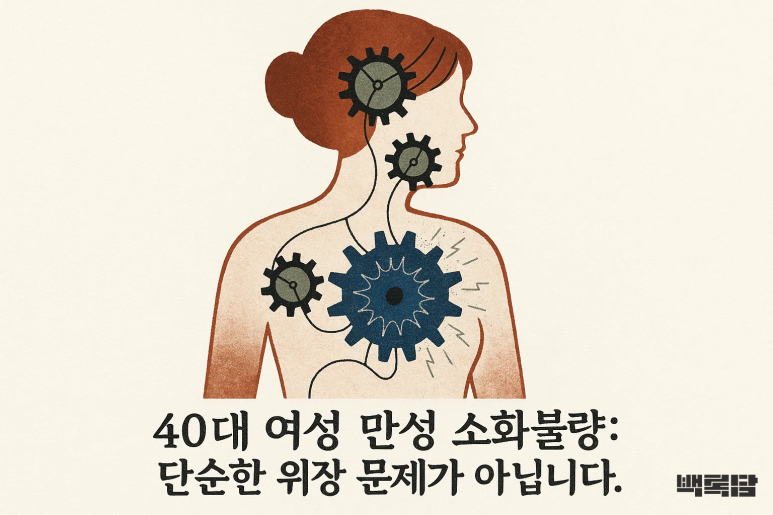
The unexpected main culprit behind abdominal gas could be SIBO (Small Intestinal Bacterial Overgrowth).
Normally, most gut bacteria should reside in the 'large intestine'. However, SIBO is a condition where, due to various reasons, these bacteria reflux into the 'small intestine' and excessively multiply. The problem is that the small intestine is where the food we eat is in the preliminary stage before complete digestion and absorption.
These bacteria in the small intestine feed on undigested food, especially certain sugar components (FODMAPs), and ferment them, producing large amounts of hydrogen and methane gas. This is the direct cause of the persistent abdominal bloating and gas.
In Korean medicine, this condition is viewed through the concepts of 'Jangnae Seupdam (Intestinal Damp-Phlegm)' or 'Damjeok (Phlegm Accumulation)'. This refers to a state where unnecessary waste products, bacteria, and the turbid gases they produce stagnate in the small intestine, much like a 'damp and murky fog'.
Interestingly, recent research in modern medicine has revealed that this phenomenon is deeply related to the impaired function of the 'Brain-Gut Axis'. In particular, our small intestine has an 'automatic cleaner' function called the 'Migrating Motor Complex (MMC)', which periodically cleanses the bowel. Impaired MMC function is known as one of the major risk factors for developing SIBO.
Moreover, stress can affect the autonomic nervous system, leading to abnormalities in these intestinal motility functions. This resonates with the insight in Korean medicine that stress (Seven Emotions, 七情) damages the functions of the Spleen and Stomach (Biwi, 脾胃).
3 Ways to Give Your Small Intestine 'Rest' and 'Order'
By understanding these principles, we can approach new solutions to the problem. The key to managing SIBO and restoring the intestinal environment is to give the 'small intestine' rest and time for its natural cleansing function to recover.
- Try maintaining a 4-hour fast between meals.
The small intestine's 'automatic cleaner' (MMC) works most actively in a fasted state, without food. Simply reducing snacks and allowing sufficient time between meals can give the small intestine an opportunity to cleanse itself. - Temporarily try a 'Low-FODMAP' diet.
This is a way to temporarily reduce the bacteria's 'food source'. After stabilizing the small intestinal bacteria by avoiding high-FODMAP foods like garlic, onions, wheat, and dairy products for 2-3 weeks, gradually reintroducing foods one by one to find what suits your body can be helpful. - Drink a cup of 'warm ginger tea' after meals.
Ginger is traditionally used in herbal medicine to warm the stomach and aid digestion. Recent studies have also revealed that ginger's gingerol component has the effect of promoting gastrointestinal motility. It can gently support small intestinal movement and help with gas expulsion.
The Start of Your Journey Towards a Healthy Daily Life
Abdominal gas may not simply be due to eating the wrong foods. It could be a sign that the 'order' within our body's complex system has broken down. Listen to your body's signals through the small habits we've introduced today.
Nevertheless, if the discomfort persists, do not struggle alone. You may need expert help to restore the balance of your disrupted gut environment and address the root cause. Like the aesthetics of 'Jeongjungdong' (Movement within Stillness), we will accompany you on your journey to regain healthy movement within tranquility.
References
[1] Deloose, E., & Tack, J. (2016). Redefining the functional roles of the gastrointestinal migrating motor complex and motilin in small bacterial overgrowth and hunger signaling. American Journal of Physiology-Gastrointestinal and Liver Physiology, 310(4), G228-G233.