
Epigastric Discomfort After Meals | Incheon Epigastric Discomfort

Table of Contents
- 2. The Sensation of Something 'Stuck' in the Epigastrium: What Exactly Does It Feel Like?
- 3. Is It Really Just 'Indigestion'? Why Differential Diagnosis Is Necessary
- 4. Epigastric Pain from a Traditional Korean Medicine Perspective – A Pathological State Beyond Simple Indigestion
- 5. Treatment Strategy – Not Simply Stimulating the Stomach, but Releasing the Flow
- 6. The Patient's Language Is a Map of Their Symptoms
Hello. This is Baengnokdam Korean Medicine Clinic.
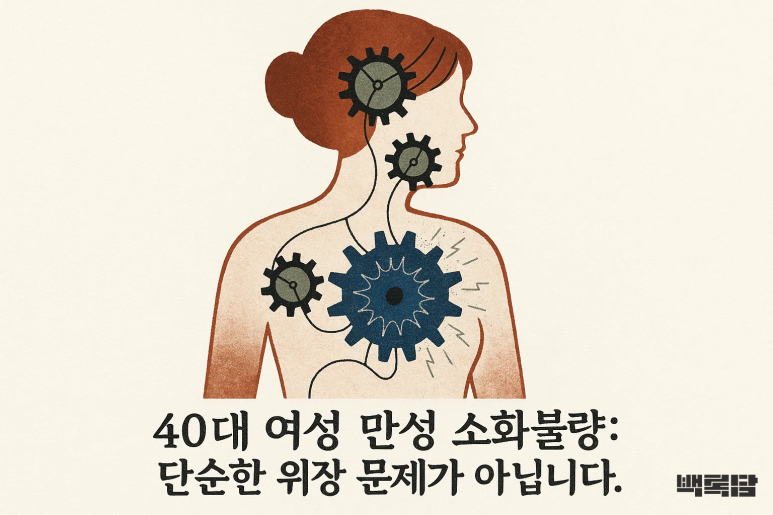
After eating, I always feel a sensation of something getting stuck. It feels like my epigastric region is blocked, as if something just won't go down. Thinking it might be indigestion, I've tried taking digestive aids and gas medicine, but... my stomach feels bloated, and strangely, I get a sensation of something rising up to my throat. Many people describe these symptoms. It's often dismissed as just “indigestion,” but in reality, much more complex symptoms are often intertwined.
2. The Sensation of Something 'Stuck' in the Epigastrium: What Exactly Does It Feel Like?
What patients refer to as ‘epigastric pain’ typically corresponds to the upper part of the stomach, specifically the epigastric region (epigastric region). However, it encompasses various layers of symptoms.
- Physical 'Stuckness': The feeling that food isn't going down properly
- Mechanical Pressure: A feeling of upper abdominal distension or tightness after eating
- Nervous Tension: A sensation of the epigastrium constricting even before swallowing
- Discomfort Similar to Acid Reflux: A burning sensation inside, even without actual acid reflux
Thus, the single term 'stuckness' actually encompasses several interpretable sensations.
3. Is It Really Just 'Indigestion'? Why Differential Diagnosis Is Necessary
Most people tend to think of “indigestion” as solely a problem with gastrointestinal function. However, in the following cases, differential diagnosis is absolutely essential:
- Esophageal Spasm (esophageal spasm): Difficulty swallowing food and a persistent constricting sensation in the epigastrium
- Gastric Atony (gastric atony): Food is swallowed, but it doesn't move down properly from the stomach, leading to persistent bloating
- Diaphragmatic Tension: The stomach's physical space is sufficient, but excessive pressure between the thoracic and abdominal cavities causes a 'blocked sensation'
- Qi Stagnation and Phlegm-Dampness: In Traditional Korean Medicine, this can manifest as internal pressure when the flow of Qi is blocked or when phlegm-dampness accumulates
This is why it cannot be resolved with just one gastrointestinal medication. Don't be misled by the phrase, 'My stomach feels bloated'.
4. Epigastric Pain from a Traditional Korean Medicine Perspective – A Pathological State Beyond Simple Indigestion
In Traditional Korean Medicine, the epigastric region is referred to as ‘Simha (心下),’ and this area is influenced not only by the stomach but also by the Liver, Gallbladder, and Pericardium meridians. Specifically, the following patterns are frequently observed:
- Qi Stagnation Invading the Stomach (氣滯犯胃): A pattern where stagnant Qi, often due to stress, oppresses the stomach
- Stomach Heat (胃熱): A burning sensation inside, with irritative pain similar to gastritis
- Phlegm Stagnation (痰鬱): A sensation of internal viscous fluids (phlegm) accumulating in the stomach without being expelled
- Spleen Deficiency with Dampness-Confinement (脾虛濕困): A condition where the stomach and spleen are weakened, leading to food stagnation and easy epigastric bloating
These pathological patterns, unlike simple ‘digestive function impairment,’ can also be linked to complex emotional and autonomic nervous system backgrounds.
5. Treatment Strategy – Not Simply Stimulating the Stomach, but Releasing the Flow
For these symptoms, simple digestive aids or gastrointestinal stimulants can actually worsen the condition. Traditional Korean Medicine treatment proceeds in the following directions:
- Resolving Qi Stagnation: Using acupuncture to release 'Qi stagnation' in the abdomen (especially utilizing points like Jungwan, Danjung, Taechung)
- Diaphragmatic Relaxation: Diaphragmatic recoil techniques, abdominal breathing training
- Harmonizing Digestive Function: Herbal medicine prescriptions that simultaneously consider strengthening spleen-stomach function and clearing stomach heat
- Alleviating Stress Response: Also regulating upper abdominal tension associated with sympathetic hyperactivity
Particularly, if patients describe sensations like ‘my epigastrium feels constricted’ or ‘I feel like I need to burp when I press it,’ it is highly likely to be a problem with diaphragmatic or thoracoabdominal pressure, requiring a combination of structural adjustment and Traditional Korean Medicine approaches.
6. The Patient's Language Is a Map of Their Symptoms
“My stomach feels sour, and my epigastrium is tight.”
“Whenever I eat, my epigastrium just gets stuck.”
“It feels like I need to burp, but I can't, like gas is trapped in my stomach.”
“I feel like I can't breathe, and something is rising up to my throat.”
These descriptions should not be simply dismissed as ‘indigestion.’ These words are a map sent by the person’s body, and clues. If a doctor or Korean medicine practitioner can read that map well, they can open the path to recovery more quickly, more accurately, and with less suffering.
#EpigastricStuckness #EpigastricTightness #PostMealEpigastricTightness