
Why do you get indigestion before your period?

Table of Contents
- 1. Do you only experience stomach upset before your period?
- 2. Cycle and Sensation — Why do symptoms worsen right before menstruation?
- 3. A Period When Vulnerable Structures Are Revealed — It's Not a Sudden Illness
- 4. Is It a Stomach Issue, or a Sensory Structure?
- 5. Treatment Is Not Suppression, But 'Condition Restoration'
- 6. Premenstrual Symptoms Are the Body's Structural Language
1. Do you only experience stomach upset before your period?
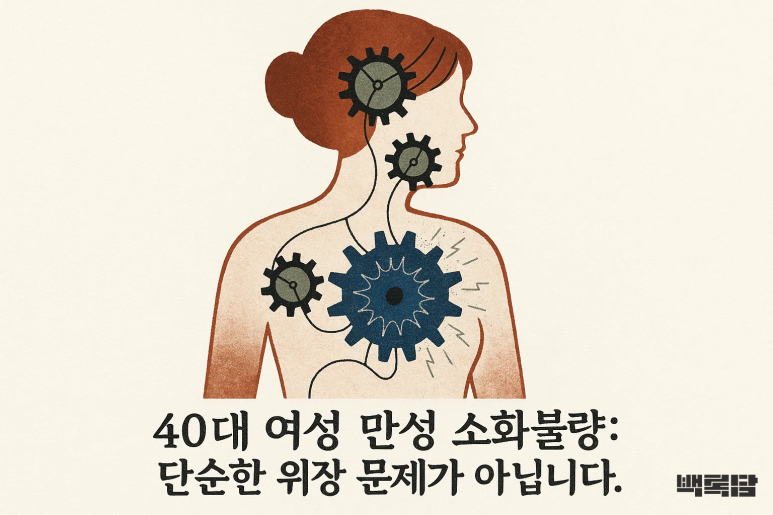
Many individuals repeatedly find themselves feeling bloated and experiencing a loss of appetite right before their period, unlike their usual state. There might be a sudden increase in burping, or nausea accompanied by an empty stomach sensation, and gas distension. This discomfort isn't simply due to a weak stomach; it could be a sign that the body's regulatory structures are temporarily disrupted. Changes during this period aren't solely stomach-related. It's a time when the coordination of the body's entire sensory circuitry is unstable, and the premenstrual period is not merely about changes in the reproductive system, but a complex time when systemic sensation, autonomic nerves, and emotional rhythms are all simultaneously affected. Rather than suppressing these symptoms, it's important to understand the structural context in which they arise.
2. Cycle and Sensation — Why do symptoms worsen right before menstruation?
In the late luteal phase after ovulation, the few days just before menstruation begins are when estrogen and progesterone levels rapidly decline simultaneously. This sharp drop in hormones is not limited to the reproductive system; it leads to a decrease in systemic sensory thresholds, reduced autonomic nervous system regulation, and a slowing of brain-gut axis function. In other words, this period is a 'time when sensory thresholds are lowered'. Stimuli that would normally be ignored become 'sensitized' into uncomfortable symptoms during this time. We refer to such a sensitive period, where symptoms are easily manifested, as a 'sensitization window'. The premenstrual period is precisely a window into such a structure.
3. A Period When Vulnerable Structures Are Revealed — It's Not a Sudden Illness
The sensitization window reveals 'vulnerable links' that were already present in the body. For those with somewhat slow gastric motility, a combination of decreased fundic compliance and delayed gastric emptying during this period can lead to bloating, loss of appetite, and postprandial lethargy. This is a result of the stomach's regulatory structures temporarily becoming dysregulated. Furthermore, in individuals with a sensitive autonomic nervous system, premenstrual sympathetic overactivity can lead to reduced gastric blood flow, increased sensitivity of the gastric mucosa, and even normal gastric acid or digestive enzyme activity being perceived as discomfort. In cases of high visceral hypersensitivity, even mild gas or bloating can be perceived as pain. Ultimately, premenstrual indigestion is not merely a simple gastrointestinal disorder, but rather a dysregulation of existing loops and a sensitization phenomenon of underlying functional issues. It's not an illness that appeared suddenly, but rather the temporary breakdown of an inherently sensitive structure manifesting as symptoms.
4. Is It a Stomach Issue, or a Sensory Structure?
Many interpret symptoms during this period as gastritis, excess stomach acid, or enteritis. However, when no abnormalities are found on examination, the true cause is more likely to lie in the sensory circuitry rather than the stomach itself. During this period, gastric motility slows, fundic distensibility decreases, and the response threshold of sensory receptors lowers. Simultaneously, emotional tension such as anxiety and mood swings are also transmitted to the stomach, increasing abdominal tension. This should be viewed not as a physical problem of the stomach, but as a gastric structure with an overactive sensory loop.
5. Treatment Is Not Suppression, But 'Condition Restoration'
When discomfort recurs, people tend to seek medication, but in a state of lowered sensory thresholds, drugs like antacids or antispasmodics may not provide sufficient relief. The true solution lies in restoring the conditions that can normalize sensory thresholds. These conditions include sleep rhythm, meal intervals, diaphragmatic breathing, thermoregulation, and stress perception adjustment, and the sensory sensitization during this period is deeply linked to a failure in autonomic nervous system conditioning. In traditional Korean medicine, a personalized approach to regulate conditions like liver qi stagnation, spleen and stomach weakness, and autonomic dysregulation is crucial, and individual adjustments based on the menstrual cycle are also necessary.
6. Premenstrual Symptoms Are the Body's Structural Language
Premenstrual symptoms are not a sign of the body being temporarily broken, but rather a moment when the tense balance of functional structures is disturbed. Rather than forcibly suppressing them, understanding the regulatory structures underlying your body and designing conditions for recovery can be the start of healing. Sensation is a precursor to function, and fluctuations in sensation can be an opportunity for regulation. Recurring premenstrual discomfort is not just a distressing time, but can be a chance to regain regulatory control. Now, try to restore those conditions.
#premenstrualindigestion #Incheonpremenstrualindigestion