Normal on Brain Scans... But Recurring Panic Attacks? The Culprit Could Be a 'Stiff Gut'.

|
"I feel like I'm going to die. My heart suddenly races like crazy, and I can't breathe. A sense of terror that I might actually die overwhelms my entire body." |
|
CASE STUDY |
|
This is the story of Ms. A, an office worker in her mid-30s. She visited a neuropsychiatrist for panic attacks that started a year ago. Brain MRI and electrocardiogram results were all 'normal'. The doctor diagnosed her with panic disorder due to stress and prescribed an anxiolytic (alprazolam). Her anxiety definitely decreased after taking the medication, but as the effects wore off, the shadow of anxiety inevitably returned. |
However, Ms. A had one more long-standing problem: persistent chronic indigestion. Her epigastric region was always uncomfortable, and she would often get stomach upsets with even a little stress.
She, however, never imagined these two problems could be connected.
|
If there are no structural problems in the brain and no abnormalities in the heart, why does the body feel a threat to its life? Anxiolytics can temporarily suppress the brain's overreaction, but what initially triggers such a strong 'false alarm' in the brain? This is the limit of existing explanations and a new clue we need to explore. |
The key to solving this complex mystery may lie not in the 'brain' but in the 'gut'. It's like a house's fire alarm constantly ringing, but the cause isn't smoke; it's an electrical short circuit within the alarm itself.
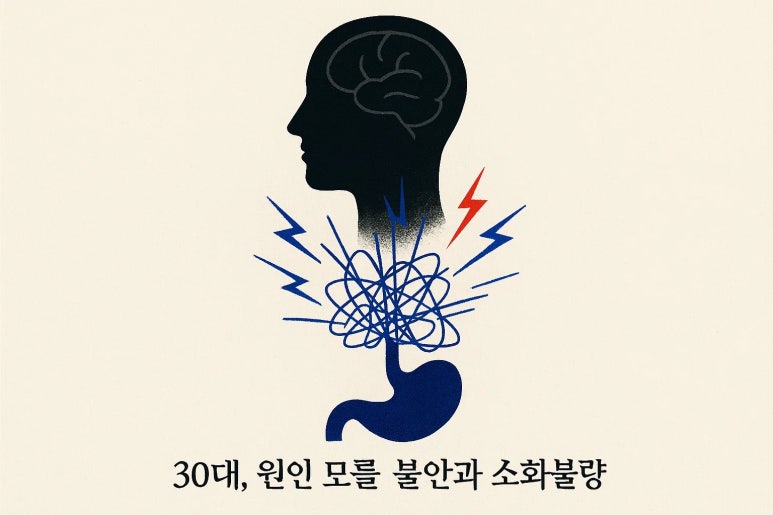
The most crucial information highway connecting the brain and the gut in our body is the 'Vagus Nerve'. Information about the gut's condition is reported to the brain in real-time via this nerve.
|
📖 Terminology: Dam-jeok (痰積) In traditional Korean medicine, the phenomenon where tissues around the stomach and intestines swell and harden due to chronic digestive problems, like in Ms. A's case, is called 'Dam-jeok (痰積)'. 'Dam (痰)' refers to abnormal body fluids that become viscous due to stress or inflammation, while 'jeok (積)' signifies the accumulation of these fluids into a mass. Just as rust and debris clog pipes in an old building, obstructing water flow and abnormally increasing water pressure, Dam-jeok accumulates on the stomach lining, impeding the normal circulation of digestive fluids and blood. |
The Dam-jeok formed in this way physically compresses the tissues around the stomach and intestines, and the inflammatory substances produced here continuously irritate the vagus nerve. From the vagus nerve's perspective, unexplained 'crisis signals' are constantly ascending from the gut.
When the brain interprets these signals, it may mistakenly perceive them not as 'indigestion' but as a life-threatening 'serious problem in the body'. Consequently, it mobilizes the sympathetic nervous system, causing the heart to race and breathing to become rapid to prepare for a crisis, which could be the hidden mechanism of panic attacks.
Therefore, stabilizing the brain with anxiolytics is like reducing the sound of a ringing alarm. While certainly necessary in urgent situations, if the fundamental cause triggering the alarm, 'gastric Dam-jeok,' is not addressed, the emergency bell can ring again at any time. Indeed, many patients with anxiety disorders simultaneously report gastrointestinal symptoms, suggesting a deep connection between the two.
|
If you are suffering from recurring anxiety and physical symptoms despite having no abnormalities detected by tests, you need to shift the direction of your questions. Not 'Why is my brain so sensitive?' but 'What keeps triggering my body's alarm system?' Therefore, instead of the abstract goal of 'eliminating anxiety,' setting a concrete goal of 'creating a comfortable stomach that digests well' can be the first step towards solving the problem. If you meet a specialist with this new perspective, the question you should ask goes beyond 'What medication will reduce my anxiety?' Instead, you will be able to ask a question that penetrates the core of the problem, such as, 'What approach is needed to relieve chronic inflammation and tension in my body and correct the communication issues from my gut to my brain?' |