
Chronic Pain in My Body, 'Damjeok-byeong' Could Be the Real Cause | Damjeok-byeong Self-Diagnosis

Table of Contents
- Could I Have It? Damjeok-byeong Self-Diagnosis Checklist
- [Digestive Symptoms]
- [Systemic Symptoms]
- Checking Your Results
- Why Damjeok Spreads Throughout the Body
- Nervous system symptoms:
- Musculoskeletal symptoms:
- Association with autoimmune diseases:
- How do we detect and treat damjeok?
- Core principles of damjeok treatment
- Acupuncture
- Herbal medicine
- How to manage damjeok on your own
- 1. Abdominal self-pressure method & acupoints
- 2. Lifestyle habit correction
- 3. Using supplements as an adjunct
- Treatment, how should I start at which hospital?
- How long does treatment (treatment period) take?
- Curious about Korean medicine clinic costs?
- The 'Golden Time' of Damjeok treatment
"I can't digest properly, but I don't know why my back keeps hurting."
"Sometimes my arms and legs go numb, so I even got a brain scan, but they said nothing was wrong."
"Because of chronic fatigue, I went to internal medicine, orthopedics, and neurology, but all I heard was 'stress-related.'"
Do symptoms like unexplained full-body pain accompanied by indigestion sound familiar to you?
Many people visit multiple hospitals following each individual symptom, but end up exhausted without getting a clear answer. But what if the root of all these symptoms was a single cause—simply a 'hardened stomach'?
Hello, I am Dr. Choi Yeon-seung, director of Baekrokdam Korean Medicine Clinic, who has been identifying 'damjeok-byeong' (damp stagnation syndrome) as the underlying cause in countless patients with 'unexplained' pain over the past 15 years. In this article, I will first help you self-check whether your symptoms correspond to damjeok-byeong, explain what damjeok (damp stagnation) actually is and why it develops, and then walk you through how it can be resolved.
Could I Have It? Damjeok-byeong Self-Diagnosis Checklist
Damjeok-byeong cannot be clearly identified through hospital tests. You must be wondering if your symptoms apply too, right?
Below are the most common representative symptoms observed in patients with damjeok-byeong. Take a moment to calmly check how many apply to you.
[Digestive Symptoms]
- □ The pit of your stomach feels tightly blocked like a lump of rock, and you often feel choked.
- □ Your abdomen bloats and you get gassy even after eating just a little.
- □ You frequently feel nauseous, burp often, and sometimes experience nausea.
- □ You have chronic diarrhea, or constipation and diarrhea alternate.
- □ Bad breath seems to have gotten worse, and white coating frequently forms on your tongue.
[Systemic Symptoms]
- □ Unexplained headaches or dizziness occur several times a month.
- □ The back of your neck and shoulders are always stiff, and back pain is especially severe along the inside of the shoulder blade.
- □ Even after getting enough sleep, exhaustion doesn't go away—you suffer from chronic fatigue.
- □ You feel your heart racing or experience anxiety for no apparent reason.
- □ Sometimes you experience tingling or numbness in your arms or legs.
Checking Your Results
Do 3 or more of the items above apply to you? If so, there is a high likelihood that the cause of your discomfort is 'damjeok-byeong.'
Why Damjeok Spreads Throughout the Body
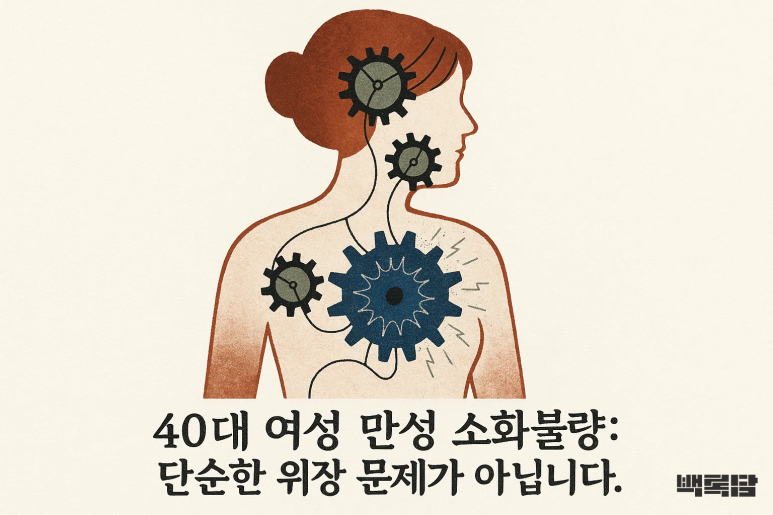
The cause of damjeok-byeong lies in the functional rigidity—essentially, the 'hardening'—of the outer wall of the stomach. Like a rubber band that has aged and hardened, the muscle tissue of the stomach and intestines loses elasticity and becomes stiff.
The hardened stomach cannot perform proper peristalsis, causing chronic indigestion, and in this process, it produces large amounts of 'damp stagnation toxins.' The problem is that these toxins do not simply stay within the intestines. Through 'Leaky Gut,' they break through the weakened intestinal barrier and spread throughout the body via blood vessels and the lymphatic system. This is the real reason why systemic symptoms—ones that could not be explained—appear alongside indigestion.
Nervous system symptoms:
Damp stagnation toxins travel through the blood, causing inflammation in the nervous system and potentially disrupting peripheral nerve circulation. This is the key mechanism behind symptoms such as headaches and dizziness, as well as arm tingling and leg numbness.
Musculoskeletal symptoms:
Toxins tend to accumulate in areas where blood circulation is not smooth. In particular, they build up in areas like the back and shoulders where muscles tend to become stiff, causing chronic back pain and myalgia.
Association with autoimmune diseases:
Furthermore, chronic damp stagnation toxins can disrupt our immune system. They may become a trigger or aggravating factor for autoimmune diseases, in which immune cells mistake normal cells for enemies and attack them.
Studies showing this are being actively conducted recently.
Therefore, damjeokbyeong should be understood as a "systemic disease" that destroys the balance of our entire body, beyond a simple digestive disorder.
How do we detect and treat damjeok?
How does traditional Korean medicine detect damjeok that cannot be seen even with examination equipment like endoscopes? The most important diagnostic criterion is "bukjin (abdominal diagnosis)" performed at the fingertips of a Korean medicine doctor.
Just as a skilled expert can identify the cause of a problem simply by listening to the sound of a car engine, a Korean medicine doctor presses directly on the abdomen to carefully assess the degree of hardening of the gastrointestinal wall, areas of pain, and distribution of gas. By combining this with tongue condition (tongue diagnosis) and pulse flow (pulse diagnosis), they comprehensively evaluate the body's qi and blood circulation to make a final diagnosis.
Core principles of damjeok treatment
The goal of damjeok treatment is not simply to suppress symptoms, but to restore the hardened stomach to softness and regain its ability to work on its own.
Acupuncture
Acupuncture acts like a switch that releases knotted muscles. By directly stimulating over-tense abdominal fascia and muscles, it relieves tension, promotes blocked qi and blood circulation, and reduces back pain or abdominal pain.
Herbal medicine
Herbal medicine works to melt hardness from within. Using herbs that soften hardened damjeok and herbs that eliminate toxins accumulated in the body, the treatment aims to restore the stomach's natural softness and mobility.
How to manage damjeok on your own
Along with professional treatment, consistent daily management is the most important key to enhancing the effectiveness of damjeok treatment and preventing recurrence.
1. Abdominal self-pressure method & acupoints
The best way to soften a hardened abdomen is a "warm massage."
[Abdominal massage]
Before going to sleep, lie down comfortably and rub your palms together to warm them, then place them around your navel. Massage the entire abdomen in a clockwise direction, drawing soft but deep circles for about 10 minutes. This helps promote intestinal peristalsis and relax knotted muscles.
[Key acupoints]
It is also helpful to gently press the "Jungwan acupoint" located at the exact center between the pit of the stomach and navel, and the "Cheonchu acupoint" located two finger-widths on either side of the navel.
2. Lifestyle habit correction
Damjeok is ultimately a disease formed from accumulated incorrect lifestyle habits.
[Diet]
The most important thing is to "chew thoroughly and eat slowly." When food is well broken down, the burden on the stomach decreases. Foods that worsen damjeok, such as flour, greasy foods, and cold beverages, must be strictly avoided. Good food is fundamentally warm and soft.
[Stress]
Chronic stress disrupts the autonomic nervous system, keeping the abdomen constantly tense. Consciously take time to release body tension through light walking, meditation, or diaphragmatic breathing.
3. Using supplements as an adjunct
While not the core of damjeok treatment, some supplements can provide adjunctive assistance in improving digestive function. For example, digestive enzymes help break down food and reduce the stomach's burden, and certain probiotics can improve the intestinal environment and help alleviate gas or diarrhea symptoms. However, supplements may instead become a burden depending on the individual's condition, so it is strongly recommended to consult with an expert before taking them.
Treatment, how should I start at which hospital?
If you are suffering from chronic damjeokbyeong that cannot be resolved with lifestyle habit correction alone, you need professional help. Which hospital should you go to?
Since damjeokbyeong is a "functional" problem of the stomach "outer wall," it is important to find a Korean medicine clinic that can accurately diagnose and fundamentally treat it. In particular, it is recommended to check whether the clinic thoroughly examines stomach condition through bukjin (abdominal diagnosis).
How long does treatment (treatment period) take?
Damjeok is a chronic issue that forms slowly over the course of several years. Therefore, the treatment period does not end in a short time either. It varies depending on the patient's condition and the severity of symptoms, but in general, consistent treatment and lifestyle management for 3 months to 6 months or more are necessary. This is a process of loosening hardened tissue, expelling toxins, and allowing stomach function time to recover on its own.
Curious about Korean medicine clinic costs?
The cost of Damjeok treatment varies depending on the patient's condition and treatment period, and mainly consists of herbal medicine prices and acupuncture treatment fees. Treatments such as acupuncture or pharmacopuncture are often covered by national health insurance, but herbal medicines that directly remove Damjeok are classified as non-insured items. You can receive transparent guidance on exact Korean medicine clinic costs during your visit and consultation, along with an accurate diagnosis of your current physical condition.
The 'Golden Time' of Damjeok treatment
The golden time for Damjeok treatment is when systemic symptoms beyond simple indigestion begin to appear, such as back pain or arm numbness. This is a strong signal that Damjeok toxins have already spread throughout the body.
No longer suffer from pain of 'unknown cause.' If you understand the signals your body is sending and seek the right solution, you can certainly break free from the relentless grip of Damjeok.#DamjeokDisease #DamjeokSelfDiagnosis