
Why Doesn't IBS Respond Well to Treatment? | Songdo IBS

Table of Contents
- Hello, this is Baengnokdam Korean Medicine Clinic.
- Not the Bowel Itself, But a Problem with the System Surrounding It
- What is this regulatory system?
- Why Medication Alone Is Insufficient
- Recovery Comes Not from the Bowel, but from Your Entire Self
- Treating the Body's Regulatory Capacity, Not Just Symptoms
Hello, this is Baengnokdam Korean Medicine Clinic.
Taking Medicine, But Your Gut Remains Unchanged? – What We’re Missing About Irritable Bowel Syndrome
Many patients who visit our clinic often say things like this:
“I was diagnosed with Irritable Bowel Syndrome at the hospital. I’ve tried medication, but… I don’t really feel better. I even wonder if I should just stop taking it.”
These kinds of statements usually contain two mixed emotions:
- One is the frustration with persistent abdominal pain, irregular bowel movements, and frequent diarrhea or constipation.
- The other is a vague distrust of continuing to take medication.
But actually, these statements aren't that strange. Irritable Bowel Syndrome is inherently a condition with no clear response to medication.
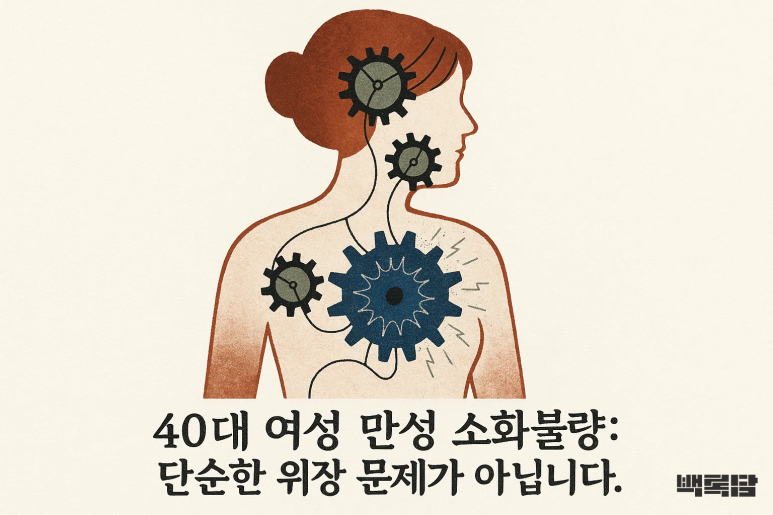
This is because the problem isn't with the structure of the intestines themselves, but rather with a disruption in the 'nervous system and rhythm' that regulate bowel movements.
Not the Bowel Itself, But a Problem with the System Surrounding It
The reason why Irritable Bowel Syndrome is not simply viewed as a bowel problem is clear. Abdominal pain, diarrhea, incomplete bowel movements... these symptoms recur, yet when a colonoscopy is performed, no abnormalities are found.
So, it's not that the structure is damaged; rather, the regulatory system is out of order.
What is this regulatory system?
It is the autonomic nervous system, and the communication between the brain and the gut.
The reason why our gut reacts immediately when we're stressed, the reason we feel the urge to defecate as soon as we wake up in the morning, the reason our stomach hurts when we're anxious… In Korean medicine, these states are explained by concepts such as 'imbalance of Spleen and Stomach,' 'Liver Qi invading the Spleen,' or 'Qi stagnation.'
In particular, the Liver (肝) organ in Korean medicine is not merely a detoxification organ, but also plays a role in relaxing tension and regulating the flow of Qi and Blood.
When the Liver becomes rigid (stagnant) and the Spleen-Stomach become weak, the intestines cannot move properly on their own. In such a situation, it's natural that a single pill won't solve the problem.
Why Medication Alone Is Insufficient
Here's the important point: Medications typically focus on suppressing symptoms. Medications to reduce diarrhea, medications to reduce gas, medications to relax the bowels.
However, they don't provide an answer to 'why these symptoms keep recurring.' Furthermore, many people react sensitively to such medications.
Some feel more discomfort in their gut after taking them, or even feel as if their bowels have stopped moving.
In such cases, rather than focusing on the drug's action, we need to address the body's sensitivity, specifically, the tense state of the nervous system itself.
Recovery Comes Not from the Bowel, but from Your Entire Self
In practice, when applying acupuncture treatment or prescribing herbal medicine to regulate the bowels, it's not just the abdomen that becomes comfortable; anxiety decreases, sleep improves, and overall digestive function often stabilizes.
Especially for those who alternate between recurrent diarrhea and constipation, the 'rhythm' itself is the core of the treatment.
By reducing intestinal mucosal sensitivity with herbal medicine, balancing the autonomic nervous system with acupuncture, and adjusting dietary habits and daily patterns together—only then can the body truly restore its rhythm, revolving around the individual as a whole.
Treating the Body's Regulatory Capacity, Not Just Symptoms
While the name Irritable Bowel Syndrome seems to label a disease, its essence is a breakdown in 'my body's regulatory capacity.' Korean medicine is a field that aims to restore this regulatory capacity.
Treatment that looks at the whole individual, not just the intestines. That is the necessary approach for this condition.