Talking About Functional Indigestion and Gallbladder Disease Symptoms

Table of Contents
Your stomach hurts, but they say there is nothing wrong? You experience recurring heartburn and bloating, chest pressure, intermittent headaches, dizziness, and even insomnia or depression. When you go to the hospital for tests, they say the gastroscopy is clean, there is no H. pylori, and stomach acid levels are normal. Yet your body feels uncomfortable every day. "Mealtimes are stressful." "I always feel bloated, but they say there is no diagnosis." Such experiences are packaged with the term Functional Dyspepsia. However, for patients, the word "functional" often means not the possibility of treatment but rather the despair of having no language to describe this pain.
Functional Dyspepsia – A Condition with a Name but Lacking Explanatory Power
Functional dyspepsia shows no clear lesions, either anatomically or pathologically. For this reason, it is diagnosed according to the Rome Criteria, an international standard. According to the Rome IV criteria, functional dyspepsia is defined by the following symptom groups:
- Postprandial fullness
- Early satiety
- Epigastric pain
- Epigastric burning
When one or more of these symptoms has persisted for more than 3 months and no structural abnormalities are found, the label "functional" is attached. Yet this condition was merely given a name; treatment remains uncertain. Acid suppressants, gastrointestinal prokinetics, SSRIs, low-dose tricyclic antidepressants (TCAs)… in theory they are supposed to help, but in actual clinical practice, doctors hear "it is the same even after taking them" far too often. Why is that? This condition is not merely a problem of the stomach alone; it is a collapse of neurophysiological rhythms that envelop the entire body.
Patients Say "It Is Strange"
Medicine prefers clear symptoms. "My stomach hurts," "I feel nauseous," "I vomited," things like that. But patients with functional dyspepsia do not say things like that. "Something in my gut has not felt right, I feel drained, and my upper abdomen from the pit of the stomach upward feels stuffy." "Some days my head feels foggy, and some days my mood sinks for no reason." "Even while sleeping, I feel like my digestion is not working." This is not a single symptom but multiple symptoms that arise when rhythm falters. This is a hallmark manifestation of the gut-brain axis, the interconnected pathway linking the gastrointestinal tract with the central nervous system and the autonomic nervous system.
The Meaning of "Physician-Centered Conceptual Boundaries"
The diagnosis of "functional" is the language of physicians classifying disease. This resonates with the French philosopher Georges Canguilhem's argument that "the normal should not come from statistics but from the meaning of life." In other words, saying "it is not a disease" may be received by the patient as dismissal of their suffering. The normal/abnormal scale that physicians hold is too standardized to capture patients' pain, and those boundaries ultimately produced the word "functional." Pain that is not proven yet exists – in the end, that is not a disease name but a signal that the structure of sensation and life has collapsed.
Damp-Phlegm Syndrome – Not a Diagnosis but the Patient's Narrative
Therefore, some patients find greater solace in the term "damp-phlegm" than in the word "functional." Literally interpreted, damp-phlegm means "a condition of accumulated phlegm." However, in modern Korean medicine, it is understood more broadly as a complex of signals involving autonomic nervous system disruption, impaired gastrointestinal function, and systemic imbalance. What patients describe as damp-phlegm is not simply a mass in the stomach; it refers to a state where nerves are heightened, the autonomic nervous system is unstable, the stomach is perpetually weak, and emotions are simultaneously declining. This is expressed through Korean medical concepts such as spleen-stomach deficiency, liver qi stagnation, and phlegm-stagnation conglomeration, and can be explained in Western medical terms as sympathetic dominance, reduced vagal tone, and HPA axis dysfunction.
A Disorder of Flow, to Be Treated Through Flow
Human digestion is a highly unusual process from an evolutionary standpoint. Since the advent of cooking with fire, we have evolved in a direction where energy is pre-digested from outside, reducing the burden on internal organs. However, the lifestyle of modern humans is the complete opposite of this flow. Eating quickly, sitting in static postures, prolonged sitting, high stress, shallow breathing, insufficient sleep, and low heart rate variability… all of these affect the stomach, and ultimately lead to functional gastrointestinal disorders.
or leads to a collapse of the overall rhythm such as gallbladder dampness. The reason this cannot be treated with medication alone is clear. This is not a disease of structure but a disease of flow.
That flow is the “rhythm of life,” encompassing qi, blood, breathing, emotions, movement, and digestion. Functional dyspepsia is not simply a condition caused by excess stomach acid. Therefore, responses to simplistic drug prescriptions such as acid suppressants or prokinetics are limited. Even with medication, improvements are only temporary or partial, and most patients repeatedly say, "My body stays sensitive even after taking medication," or "When one symptom improves, something else hurts." The reason is clear.
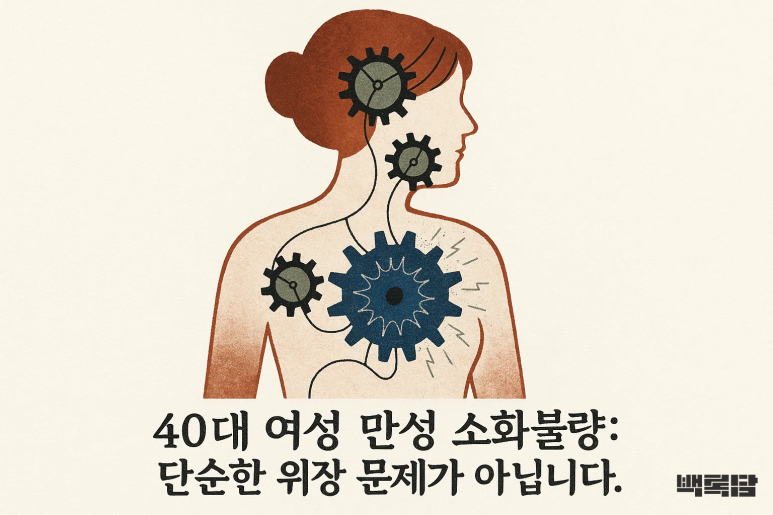
This condition is not the failure of a single “machine part" called the digestive organs; it is a comprehensive expression of the disruption of the overall rhythm of life, from the autonomic nervous system of the entire body, sensory circuits, emotional amplitude, sleep, posture, breathing, eating speed, to even interpersonal relationships. For example, the vagus nerve regulates gastric motility while simultaneously being connected to heart rate, emotional regulation, and immune responses. In addition, the movement of the diaphragm not only regulates the position and tension of the stomach but also changes the sympathetic-parasympathetic balance depending on the depth of breathing. However, the modern eating environment operates almost exclusively in ways that disrupt this rhythm. Swallowing food quickly while sitting, pressing down on the digestive organs with shallow breathing, viewing smartphones or screens, and working or driving for long periods while seated immediately after eating — such daily routines repeat in a direction that almost completely ignores the physiological collaboration required by the process of digestion, increasing only the burden on each organ. Ultimately, functional dyspepsia should be understood not as organ failure but as a failure of life's coordination.
Therefore, true treatment should not be simply “taking antacids" but should restore the body's rhythm, stabilize the autonomic nervous system, and recover the movement and coordination of visceral organs. What is important here is not the organs themselves but the flow between organs — in other words, a perspective that addresses connectivity. In Korean medicine, this is expressed through concepts such as the “flow of qi (氣)," “liver-spleen disharmony," and “gallbladder dampness internal condensation." In modern physiology, expressions such as “autonomic dysregulation," “vagal tone recovery," and “visceral motility" are used. Though the expressions differ, the core is the same. Not fixing one cause but restoring the overall flow. That flow is precisely the “metabolic rhythm of the body" we have been overlooking, and it is the essential perspective for properly understanding functional dyspepsia and gallbladder dampness disease.
#functionalDyspepsia #gallbladderDampness #IncheonFunctionalDyspepsia #IncheonGallbladderDampness