Brown rice, which I believed to be a health food, why did my stomach feel more uncomfortable the more I ate it?

Table of Contents
Brown rice, which I believed was a health food, why did my stomach feel more uncomfortable the more I ate it?
"I switched from white rice to brown rice for the sake of my health, but strangely, my stomach feels more bloated and I feel like I have gas all day. Since this happens even though I'm eating healthy things, I have no idea what I should eat."
Deep frustration was evident in the voice of Mr. K, an office worker in his 30s. After being diagnosed with irritable bowel syndrome, he paid more attention to his diet than anyone else, but the result was the exact opposite of his expectations. In particular, on days when he was nervous, eating flour-based foods invariably caused stomach pain.
Like Mr. K, many people point to 'gluten' in flour as the first suspect when they experience indigestion. In fact, Gluten intoleranceSome people experience this, but the problem may lie elsewhere than expected. This is because Mr. K felt similar discomfort even when eating bread with Gluten-free certification. This is a strong signal that we may be missing the real culprit.
The culprit may not be a specific protein called gluten, but a specific type of 'carbohydrate' itself. These are the components called 'FODMAP'.
|
📖 Terminology Explanation: FODMAP Fermentable Oligosaccharides, Disaccharides, Monosaccharides And PAn abbreviation for polyols, which in our language means 'fermentable oligosaccharides, disaccharides, monosaccharides, and polyols.' The name is complex, but the core point is that they are 'short-chain carbohydrates that are not well absorbed in the small intestine and are rapidly fermented by microorganisms in the large intestine.' |
The silent intruder, how FODMAPs work
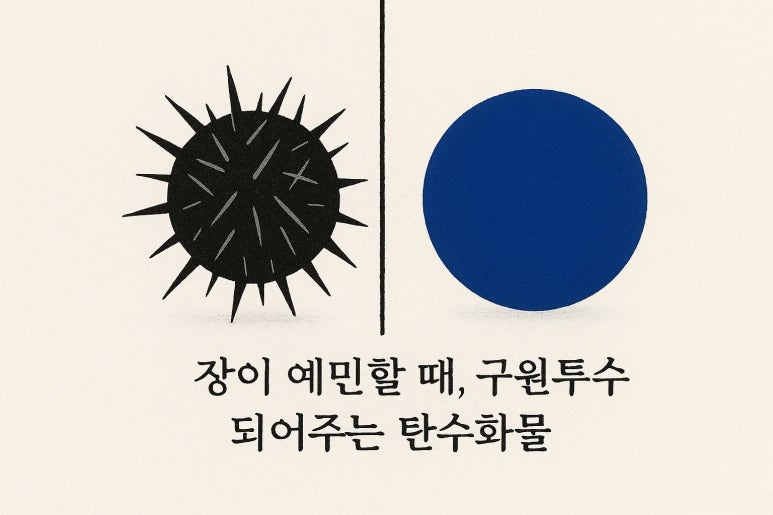
For people with healthy intestines, FODMAPs serve as good food (prebiotics) for beneficial intestinal bacteria, but the situation is different for people with sensitive intestines. When FODMAPs enter their intestines, two events occur simultaneously.
First, intestinal microorganisms feed greedily on FODMAPs, producing large amounts of gases such as hydrogen or methane. This is like It is like a large-scale festival suddenly being held in a quiet rural village, causing noise and confusion. This gas is the main culprit behind severe abdominal bloating and uncomfortable pain.
Second, FODMAPs cause an osmotic effect that draws water into the intestines. When there is excess water in the intestines, intestinal movement becomes abnormally fast, which can trigger diarrhea. In an actual study where a low-FODMAP diet was strictly followed for 2 weeks, there was also a report that the abdominal bloating scores of irritable bowel syndrome patients significantly decreased from 8 to 3 out of 10 points.
The reason rice and rice noodles are the relief pitchers
Then why were white rice and rice noodles specifically okay? The answer lies in 'simplicity.' Rice, especially white rice, has its husk and germ removed during the milling process, and these parts contain many FODMAP components.
|
Of course, the nutritional benefits of brown rice are also great, but right now we are looking at it from the perspective of 'stimulation.' |
As a result, white rice becomes a carbohydrate centered on pure starch with very low FODMAP content. Since there is almost no 'food' for intestinal microorganisms to ferment, gas production is low and it does not cause an osmotic effect. The same principle applies to rice noodles, which use noodles made from rice instead of wheat flour. Therefore,rice noodle digestionIt may be a natural result that it feels comfortable. This is the secret of easily digestible carbohydrates that many people seek.
Surprisingly, these discoveries of modern nutrition align exactly with the Korean medicine perspective that 'the energy of the Spleen and Stomach (脾胃) must be supplemented.' In Korean medicine, the Spleen and Stomach are the core power plants that digest and absorb food to convert it into the energy (Qi and Blood / 氣血) necessary for our body. It is viewed that when the Spleen and Stomach are in a weak state, if food that is overwhelming to process enters, they cannot produce energy properly and instead create waste products called 'phlegm-fluid (濕痰),' which cause problems. Refined rice minimizes the burden placed on this power plant, effectively serving as a 'therapeutic food' that buys time for the weakened system to recover on its own.
Drawing a carbohydrate map that suits me
Therefore, the journey of finding food when the intestines are sensitive must begin not simply by adding good foods, but through the process of 'removing' elements that strain my body.
|
If you felt stomach discomfort after eating brown rice or whole wheat bread, instead of cutting out carbohydrates altogether, why not try a low-FODMAP diet centered on white rice or rice noodles for about 2 weeks? |
|
This absolutely does not mean that whole grains are bad for everyone. In the long term, the fiber in whole grains is essential for intestinal health. However, if your gut is currently in an "overloaded" state, a strategy to give your system a temporary rest is needed. Rice can serve as the safest and most effective first step in reducing that overload. |
|
✅ Key Takeaways Through this new perspective, we now have the power to ask experts not "What digestive aid should I take?" but more fundamental questions like "What sequence of dietary adjustments would be good to lower my gut hypersensitivity and reduce the burden on my stomach?" This is where true change begins. |