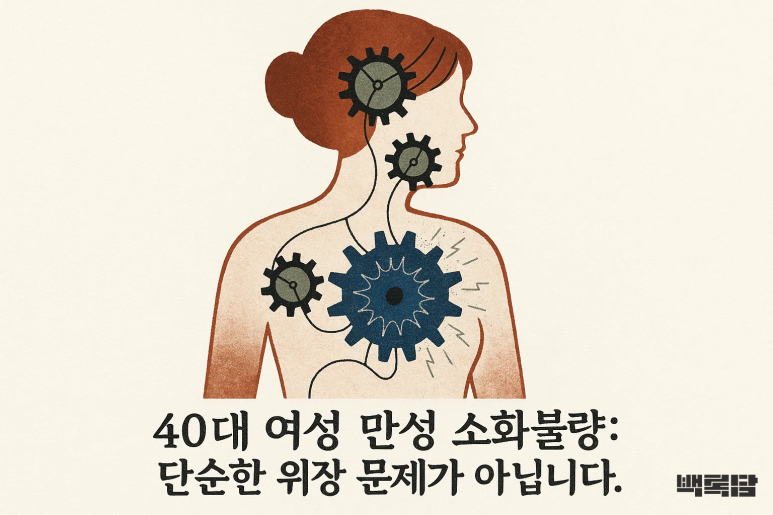

My belly is hard. What are the reasons? It might not be simple abdominal discomfort

Table of Contents
- Various languages of the body indicated by the expression ‘hardness’
- Let me give some examples.
- Then, how should we interpret this sensation?
- Six questions to distinguish “What kind of disease could this be?”
- Six types of ‘hardness’ classified by traditional Korean medicine pathogenesis
- Hard abdomen — how does traditional Korean medicine approach treatment?
- Treatment approaches
- Clinic information
It may not be simple abdominal discomfort
Hello, I am Choi Yeon-seung, a doctor of Korean Medicine at Baekrokdam Korean Medicine Clinic.
The anxiety contained in the phrase “My stomach feels hard”
I often hear these words in the consultation room.
“Doctor, my stomach feels a bit hard. I'm worried it might be something bad...”
Within those words lies not just a simple symptom, but a vague yet specific anxiety.
The expression “hard” doesn't necessarily mean it hurts, or there is heartburn, or a fever...
It is a strange abnormal sensation coming from inside the body, such as ‘a feeling that something is caught when touched’ or ‘feeling heavy and firm.’
However, that sensation sometimes feels scarier than what we call a disease. This is because it is felt even though it cannot be seen.
Is this cancer? Could something have developed in my intestines?
When searching online, scary words like tumors or cysts appear. Then, people go to the hospital and undergo tests.
From ultrasound, CT, gastroscopy, to colonoscopy...
“Everything is normal.” “It seems your intestines are just sensitive.” “It could be due to tension.” “It might be because of constipation.”...
When told this, people may become even more anxious. Because they clearly feel something, but it cannot be explained.
It's not something they made up; when they actually touch their stomach, something feels hard. In these moments, what we truly need is not simply the name of a disease, but a language that interprets ‘why this sensation occurred.’
Cases where we should not ignore it just because there is no diagnosis, but rather need a more accurate interpretation because there is no diagnosis. That is exactly the ‘hard stomach sensation’ we will talk about today.
Various languages of the body indicated by the expression ‘hardness’
In fact, ‘hard’ is a very ambiguous term. For some, it means a structure like a lump is actually felt in the abdomen; for others, it means the pressure of tense abdominal muscles; and for some, it means the bloating of gas in the intestines.
In other words, while we all use the same expression, the actual state inside the body that the expression refers to can be very different.
Let me give some examples.
“My stomach is cold and tight” - A state where there is a lot of gas in the abdominal cavity or intestinal motility is decreased
“My stomach feels heavy and tense” - Rectus abdominis tension, gastrointestinal stress, visceral hypersensitivity
“My stomach becomes hard before menstruation” - Congestion of blood flow around the uterus, hormonal changes
“It feels like a lump when pressed, but tests say there is nothing” - Tension in the submucosa of the gastrointestinal tract, Damjeok (痰积) state
Ultimately, the word ‘hard’ is not an objective physical state, but a language combining subjective sensation and the body's reaction.
However, when this sensation repeats or persists for a long time, people become anxious. Because it feels like evidence that the body is detecting something wrong.
In fact, among those who complain of such sensations, there are quite many cases where there are no problems even after gastroscopy and CT scans.
Then, how should we interpret this sensation?
That is the real diagnosis we must perform. Interpreting the root of the sensation, not just the symptom.
Six questions to distinguish “What kind of disease could this be?”
There are questions I always ask those who say ‘my stomach is hard’ in the consultation room. This is to determine whether this sensation is simple discomfort or a pathological signal that requires treatment.
- Since when has it been like this?
- Where is the hard area?
- Is it the entire abdomen, or only a specific area?
- Does it hurt when pressed?
Is it hard/firm?
- Are there accompanying symptoms like constipation, gas, or menstrual pain?
- Does it worsen when you experience stress?
These six questions are not simply checking off symptoms—they are clues for interpretation that give meaning to your sensations. Hardness is not just a simple state; it may be a signal of subtle structural changes being sent by your body and mind.
Six types of ‘hardness’ classified by traditional Korean medicine pathogenesis
In traditional Korean medicine, this sensation is interpreted not merely as pain or a palpable finding, but as a state of stagnation in the body’s operating systems—qi (江), blood (血), phlegm (潘), food (食), and fluid (水).
- Qi stagnation type – abdominal tension caused by stress
- Food stagnation type – a state where undigested food remains
- Blood stasis type – blood circulation has become stagnant
- Phlegm-dampness type – mucoid waste firmly lodged deep in the organs
- Cold-dampness type – rigidity due to cold energy in the organs
- Fluid stagnation type – abdominal bloating due to fluid accumulation
Hard abdomen — how does traditional Korean medicine approach treatment?
In traditional Korean medicine, the sensation of ‘hard abdomen’ goes beyond meaning that something is filling the intestines or that the abdominal muscles are tense. It is interpreted as a signal that a stagnation of movement or an imbalance of qi and blood has occurred in the deeper layers of the body.
Treatment approaches
- Qi stagnation type – Releasing the flow of ‘qi’
- Food stagnation type – Promoting elimination of accumulated food
- Blood stasis type – Restoring circulation of stagnant blood
- Phlegm-dampness type – Clearing phlegm lodged deep in the tissues
- Cold-dampness type – Releasing cold energy and restoring warmth to the abdomen
- Fluid stagnation type – Eliminating stagnant fluid and regulating water metabolism
As you can see, even one symptom of a hard abdomen is treated with a completely different design depending on its type.
“A hard abdomen is not a death sentence indicating that our body is breaking down—it is a signal of recovery and a turning point for redesign.”
Clinic information
- Consultation hours -
- Mon–Fri 10:00 AM – 7:00 PM
Lunch break 1:00 PM – 2:00 PM
※ Individual consultations are not conducted through the blog.
For reservation and consultation inquiries, please check via Naver Place or the official website.
Baekrokdam Korean Medicine Clinic Incheon Yeonsu-gu Convention Center-ro 81, Songdo Dream City 3F