Psoriasis Itch in Your 20s: Can't I Sleep Without Scratching? | Incheon Psoriasis Treatment

Psoriasis So Itchy It Drives You Crazy: Is It Possible to Sleep Without Scratching?
|
“It’s truly despairing every time I scratch all night and blood stains the sheets. Psoriasis itch makes sleepless nights a daily occurrence, and during the day, I’m busy hiding the scratched lesions from people’s eyes.” |
|
[CASE] The Vicious Cycle of a Graduate Student in Her 20s Ms. B, a graduate student in her late 20s, has been suffering from psoriasis for over 3 years. Especially when stress becomes extreme, such as during thesis deadlines or exam periods, she often loses sleep due to full-body itching. The Dermovate (clobetasol propionate) ointment she was prescribed temporarily calms the itching when applied, but it has not provided a fundamental solution. |
Her itch severity score (VAS) is normally 7 points or higher out of 10, exceeding 9 points in stressful situations. During sleep, she unknowingly woke up more than 3-4 times to scratch the affected areas. When psoriasis is scratched, it causes wounds, and those wounds, in turn, exacerbate the inflammation, creating a continuous vicious cycle.
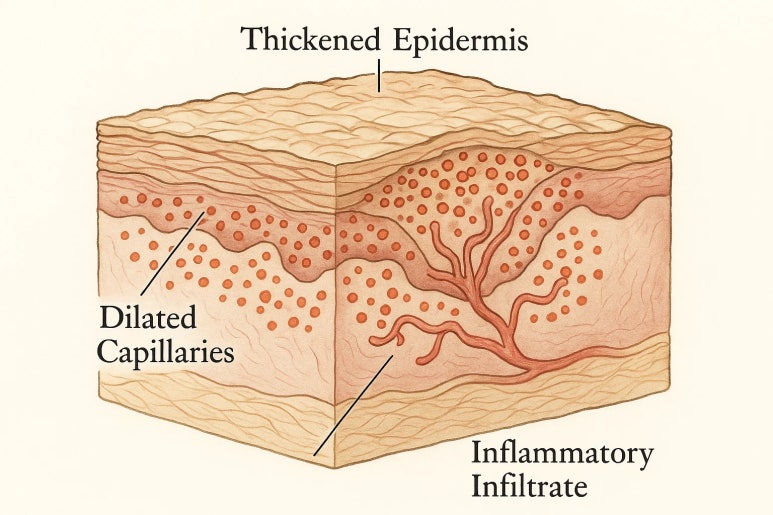
Here, we must ask an important question. If psoriasis itching were merely a skin inflammation issue, it should be controllable with steroid ointments, which are among the most potent anti-inflammatory agents available.
|
[A Critical Limitation] However, what does it mean to experience a 'rebound phenomenon' where itching worsens compared to before when the ointment is stopped, or to face problems like skin thinning due to long-term use? This is strong evidence suggesting that the root of the problem is not merely on the skin's surface, but deeper within our body—a 'systemic issue'. This is precisely the clear limitation of a perspective that confines the cause of psoriasis inflammation to the skin alone. |
The key to this unresolved problem lies in a 'shift in perspective'. It means viewing psoriasis itching not as a skin disease, but as a 'misguided signal' sent by our body's immune system.
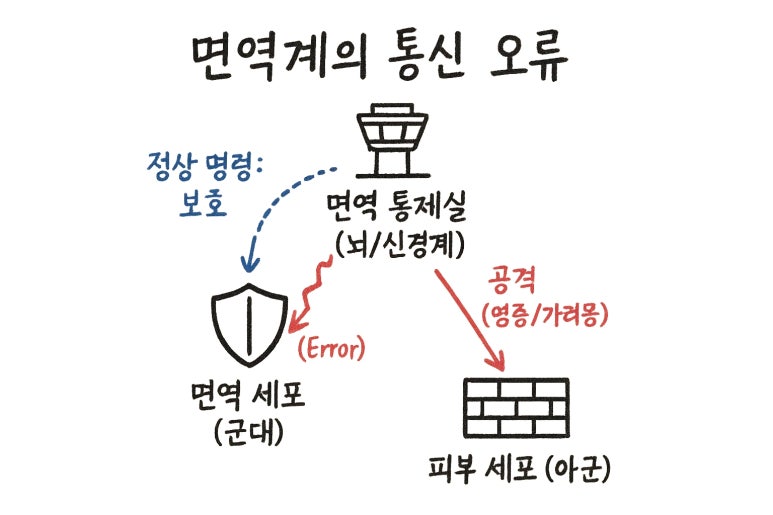
This situation is akin to 'a communication system error that continuously orders friendly forces to fire'. Our body's immune system is an army that protects us from external enemies. However, in the body of a psoriasis patient, this communication system malfunctions, causing it to mistake its own skin cells (friendly forces) for enemies and continuously issue attack orders (inflammatory responses).
The itching is, in essence, a painful 'siren' sound generated by this attack. This immune hypersensitivity reaction is the core mechanism of the autoimmune phenomenon where our body attacks itself.
Steroid ointments temporarily reduce this siren sound. However, unless the communication system's error itself is repaired, the attack orders will continue, and the siren is bound to ring again at any time.
|
[Traditional Korean Medicine Perspective: Blood Heat (血熱)] In Traditional Korean Medicine, the fundamental cause of this communication error is explained by the concept of 'Blood Heat (血熱)'. This refers to a state where the blood itself becomes heated and viscous due to stress, overwork, poor dietary habits, etc., unnecessarily stimulating and sensitizing the immune system. Therefore, the true essence of psoriasis management is to simultaneously extinguish the 'fire' on the skin, reduce this blood heat, and stabilize the immune system's communication itself. |
Is your treatment also focused solely on silencing the loud 'siren'? Have you considered correcting the fundamental error in the control room?
|
[The Start of a New Question] Now, we can change the question we ask experts. Instead of, “Which ointment is more effective?”, we can ask, “How can I stop this tragic communication error where my body’s immune system attacks its own friendly forces, and fundamentally restore stability?” This is truly the beginning of a journey to regain peace within my body, going beyond merely achieving relief from persistent itching. |